Why your waistline, insulin, sleep and pelvic floor may hold the key to better urinary and sexual health
The gland that wakes up two people at night
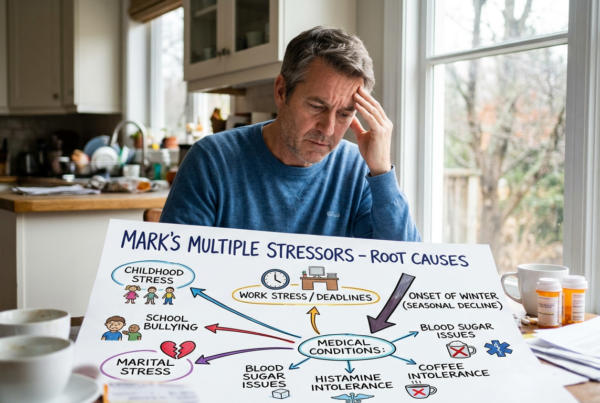
It is three o’clock in the morning. A 58-year-old man gets out of bed to visit the bathroom for the second time that night. His urinary stream is disappointingly weak. He returns to bed, struggles to fall asleep and wakes the following morning feeling exhausted.
His partner has not slept particularly well either.
Over the past decade, his waistline has expanded, his blood pressure has crept upwards, his energy has declined, and his erections are no longer what they used to be. He has been told that his prostate is enlarged and that it is a natural consequence of ageing.
But what if his expanding waistline, deteriorating metabolic health, disturbed sleep, enlarged prostate and declining sexual function are interconnected?
We have traditionally regarded the prostate as the territory of the urologist. Yet emerging science suggests we should also view it through the eyes of a metabolic physician.
The prostate: nature’s awkward piece of plumbing
The prostate is a small gland situated immediately beneath the bladder. In a healthy young adult, it weighs approximately 20 grams, roughly the size of a walnut.
Its primary function is reproductive. It produces a component of seminal fluid containing citrate, zinc and enzymes, including prostate-specific antigen (PSA), which help create a suitable environment for sperm.
It is relatively small during childhood, grows rapidly under the influence of sex hormones during puberty and reaches its adult size in early adulthood.
Unfortunately, nature has positioned it rather inconveniently.
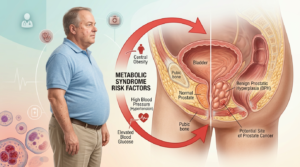
Imagine threading a garden hose through the middle of a doughnut. The hose represents the urethra, which carries urine from the bladder, and the doughnut represents the prostate.
As the inner portion of the doughnut expands, it can squeeze the hose. The bladder must then work harder to empty itself.
This is what can happen in benign prostatic hyperplasia, or BPH, a non-cancerous increase in the number of prostate cells, particularly around the urethra.
Classic pathological studies suggest that approximately half of men have microscopic evidence of BPH in their fifties, rising to around 80–90% at advanced ages. Not all develop troublesome symptoms.[1]
Does this justify removing the prostate once a man has completed his family? Certainly not. Its intimate relationship with the urinary sphincter, sexual nerves and reproductive tract makes unnecessary removal potentially damaging to quality of life.
What makes the prostate grow?
Think of the prostate as a garden. Its cells are the plants, while hormones, growth factors and inflammatory signals influence how that garden develops.
Several biological signals are particularly important.
Dihydrotestosterone (DHT). Inside the prostate, an enzyme called 5-alpha-reductase converts testosterone into DHT. This potent androgen helps regulate prostate development and maintenance.
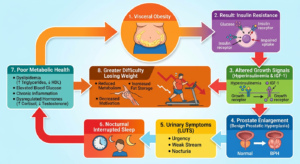
Insulin. Insulin does more than regulate blood glucose. It also participates in growth signalling. When the body becomes insulin-resistant, the pancreas frequently compensates by producing more insulin.
Insulin-like growth factor 1 (IGF-1). This belongs to a network of signals involved in cellular growth, repair and survival. Its signalling pathways interact with insulin signalling.
Oestrogens. Men also produce oestrogen, partly through conversion of testosterone by an enzyme called aromatase. Oestrogen signalling within the prostate is complex and may influence growth and inflammation.
Inflammation. Chronic low-grade inflammation may create an environment that favours abnormal tissue growth and remodelling.
DHT’s role is firmly established. The contributions of insulin, IGF-1, oestrogen, and inflammation are biologically plausible and supported by substantial research, although their precise individual contributions remain under investigation.[2–4]
The expanding waistline and the expanding prostate
Visceral fat, the fat surrounding our internal organs, is not simply a passive energy store.
Think of it as an additional endocrine organ that releases hormones, fatty acids, and inflammatory messengers into the circulation.
As visceral fat accumulates, insulin resistance often develops, accompanied by high blood pressure, abnormal blood lipids and disturbances in glucose regulation.
This cluster is known as metabolic syndrome.
A 2020 meta-analysis involving 15,317 patients found that men with metabolic syndrome had, on average, larger prostates, faster prostate growth, poorer urinary flow and more urine remaining in the bladder after urination.[3]
A further systematic review published in 2026 reinforced the association between metabolic syndrome and prostate enlargement, although the relationship with symptom severity varied between studies.[4]
The average differences in prostate volume are relatively modest. Nevertheless, they suggest that the metabolic environment may influence prostate biology.
This changes the questions we should ask a man presenting with urinary symptoms.
What is his waist circumference? Is he insulin-resistant? Does he have fatty liver disease, hypertension or type 2 diabetes? Is he physically active? Does he smoke or drink heavily?
Smoking and excessive alcohol consumption are important targets for overall health, vascular function and sleep, although their direct relationships with BPH are less consistent.
Ageing may be unavoidable. Metabolic deterioration is not necessarily so.

Nocturia: when the prostate steals your sleep
Lower urinary tract symptoms (LUTS) include a weak urinary stream, difficulty starting urination, urgency, frequency, incomplete bladder emptying and nocturia waking from sleep to pass urine.
Nocturia deserves particular attention because it may help sustain a metabolic vicious circle.
Insulin resistance and diabetes can contribute to urinary problems. Urinary symptoms may then shorten or disturb sleep. In turn, insufficient sleep can impair insulin sensitivity, increase appetite and make weight management more difficult.[5]
The cycle may become self-reinforcing.
Importantly, not every man waking at night has a prostate problem. Obstructive sleep apnoea, poorly controlled diabetes, excessive evening fluid intake, certain medications and cardiovascular disease can also contribute.
Sleep apnoea, for example, can increase nighttime urine production and repeatedly interrupt sleep.
Simply shrinking the prostate will not necessarily solve these problems.
Because nocturia frequently disturbs partners’ sleep, its consequences extend beyond the individual patient. This is a household health issue, not merely a male plumbing problem.
The prostate, erections and the vascular connection
Urinary symptoms and erectile dysfunction (ED) frequently coexist.
An erection is fundamentally a neurovascular event. Blood must enter the penis, the erectile tissues must expand, and venous drainage must be restricted sufficiently to maintain rigidity.
Insulin resistance, diabetes, hypertension, smoking and chronic inflammation can interfere with these mechanisms.
Imagine the lining of the blood vessels as a sophisticated system controlling traffic flow. When that lining becomes dysfunctional, blood cannot always reach its destination efficiently.
The penile arteries are relatively small. Erectile difficulties can therefore be an early warning of underlying vascular disease.
An enlarged prostate does not necessarily cause ED directly. Rather, both conditions may share metabolic, vascular, neurological and age-related mechanisms.
Treatment can also influence sexual function, which makes discussions about erections, ejaculation and libido essential before starting prostate medication or considering surgery.
Sexual health is not an optional luxury of youth. It remains an important component of wellbeing, intimacy and quality of life throughout adulthood.
The forgotten muscles of male sexual health
Most men understand the importance of exercising their legs, arms and abdominal muscles. Few deliberately train the muscles supporting their pelvic organs.
The pelvic floor is rather like a muscular hammock suspended beneath the pelvis. It supports the bladder and contributes to urinary continence, erections and ejaculation.
Two muscles, the ischiocavernosus and bulbospongiosus, help increase pressure within the erectile tissues and support penile rigidity.
Can training these muscles improve erections?
Encouraging evidence suggests it can.
In a British randomised controlled trial involving 55 men with ED, pelvic floor exercises combined with biofeedback and lifestyle advice improved erectile function. At six months, after the groups had received training, approximately:
- 40% had regained normal erectile function.
- 35% had improved erectile function.
- 25% had not improved.[6]
A 2019 systematic review of ten clinical trials also found encouraging results, although the studies varied considerably in quality and exercise protocols.[7]
Pelvic floor exercises can additionally help some men experiencing urinary leakage and post-urination dribbling.[8]
However, this isn’t simply about building stronger muscles. The pelvic floor must also relax appropriately during urination. Excessively tense or poorly coordinated muscles can contribute to pelvic pain and difficulty emptying the bladder.
A specialist pelvic health physiotherapist can assess whether strengthening, relaxation or coordination exercises are most appropriate.
Pelvic floor rehabilitation will not shrink an enlarged prostate, but it may improve important aspects of urinary and sexual function.

The prostate: is it a case of use it or lose it?
We encourage people to exercise their heart, lungs, muscles and brain throughout life. Should we also encourage men to maintain the natural function of their prostate?
Sexual activity is often regarded as something that gradually disappears with advancing age. But could maintaining an active sexual life have biological benefits beyond pleasure and intimacy?
In 2016, researchers studying nearly 32,000 men over 18 years reported a remarkable observation. Men who ejaculated at least 21 times a month during their forties had a 22% lower relative risk of developing prostate cancer than those ejaculating four to seven times a month.
The association was predominantly with less aggressive cancers, and the study cannot establish cause and effect. Nevertheless, it raises an interesting biological question.
The prostate is a secretory gland. During ejaculation, its muscular tissue contracts and releases prostatic fluid into the urethra.
Scientists have proposed that regularly renewing these secretions may help maintain a healthier cellular environment. They have also suggested that ejaculation might influence the unusual metabolism of prostate cells, particularly their production and secretion of citrate.
Think of the prostate as a small biological factory. Could regularly performing its natural function help keep its machinery healthy?
We do not yet know the answer with certainty.
Sexual activity also recruits the pelvic floor muscles, increases penile blood flow and may promote relaxation. In a loving relationship, it can provide emotional connection and reinforce intimacy.
Nor should these potential benefits be considered exclusive to men with sexual partners. Masturbation is a normal physiological activity and provides another means of ejaculation.
Unfortunately, there is little convincing evidence that regular ejaculation prevents benign prostate enlargement or reverses urinary obstruction. Sexual activity should therefore complement, rather than replace, metabolic and urological care.
There is no scientifically established ideal frequency of ejaculation, and sexual activity should never become a medical obligation or a source of pressure within a relationship.
The broader message is that sexual health deserves a place alongside nutrition, physical activity, sleep and metabolic health in our approach to healthy ageing.
Reproduction may cease to be a priority after middle age, but sexual wellbeing need not become irrelevant.
Perhaps one of the mistakes we make in modern medicine is to devote considerable attention to a man’s prostate while paying remarkably little attention to his sexual life.
Does prostate enlargement run in families?
BPH has a recognised hereditary component, particularly when significant enlargement develops relatively early in life.
One intriguing area of research concerns genes involved in hormonal metabolism.
The COMT gene produces an enzyme called catechol-O-methyltransferase, which participates in the metabolism of catecholamines, including dopamine, and certain oestrogen metabolites.
Common COMT variants influence enzyme activity and have been investigated in relation to cognition and hormonal metabolism.
Could these variants link prostate biology to certain cognitive characteristics?
This is an interesting research question, but evidence is currently insufficient to conclude that intellectually gifted or highly focused families are more susceptible to BPH through COMT.
Genetics may influence susceptibility. It does not eliminate the importance of the metabolic environment.
Should prostate health begin in the metabolic clinic?
I would argue that every man with BPH deserves a metabolic assessment alongside appropriate urological evaluation.
This integrated approach could include:
- Waist circumference, blood pressure, HbA1c and lipid profile.
- Nutritional assessment and reduction of excess visceral fat.
- Regular aerobic exercise and resistance training.
- Smoking cessation and moderation of alcohol.
- Assessment of sleep quality and possible sleep apnoea.
- Assess pelvic floor function and sexual health.
- A urinary symptom score, urine testing and a three-day bladder diary.
- Appropriate prostate examination, PSA testing and investigation of urinary obstruction.
A Mediterranean-style, minimally processed diet, regular movement and improved sleep provide a sensible foundation.
The metabolic clinic should address the biological environment in which the prostate exists. The urologist should assess and manage obstruction, complications and suspected cancer.
These roles are complementary, not competitive.
When lifestyle alone is insufficient
Established medical and surgical treatments remain extremely valuable.[9,10]
Alpha-blockers, such as tamsulosin, relax smooth muscle around the bladder outlet and prostate, helping urine flow more easily. They do not substantially shrink the gland.
5-alpha-reductase inhibitors, such as finasteride and dutasteride, reduce DHT production and can gradually shrink an enlarged prostate, lowering the risk of urinary retention and future surgery. Potential side effects include reduced libido, erectile difficulties and ejaculatory changes.
Tadalafil may be appropriate for selected men experiencing both ED and urinary symptoms, subject to local prescribing guidance and cardiovascular assessment.
Transurethral resection of the prostate (TURP) removes obstructing tissue from inside the gland, rather than removing the entire prostate. It can substantially improve urinary flow but may alter ejaculation. Modern laser and minimally invasive procedures offer additional options.
When obstruction threatens bladder or kidney function, surgery can be essential. Metabolic treatment must never delay necessary intervention.
PSA anxiety: moving from fear to informed action
PSA is prostate-specific, not cancer-specific.
An elevated PSA may reflect benign enlargement, inflammation or prostate cancer. Some medicines, particularly 5-alpha-reductase inhibitors, substantially lower PSA and must be considered when interpreting results.
BPH itself is not a precursor to prostate cancer.
Nevertheless, the two conditions can coexist, and early prostate cancer frequently produces no symptoms.
PSA monitoring without a broader conversation about prostate health can leave men feeling powerless and anxious.
We should replace that helplessness with an informed strategy: assess individual cancer risk, investigate abnormal findings when appropriate, and improve the aspects of health within our control.
A healthy lifestyle cannot guarantee protection from prostate cancer, and it is not a substitute for appropriate investigation.
But it can substantially improve the broader health of the man whose prostate we are monitoring.
Your Metabolic Shift: six take-home messages
- Prostate enlargement is common with ageing, but troublesome urinary symptoms should not simply be accepted.
- Insulin resistance, visceral obesity and metabolic syndrome are associated with prostate enlargement.
- Nocturia and poor sleep may contribute to a cycle of deteriorating metabolic health.
- Erectile dysfunction may be an early warning of vascular and metabolic disease.
- Pelvic floor rehabilitation can improve erections and certain urinary symptoms in selected men.
- The best approach integrates metabolic health, urology, sexual health and appropriate cancer assessment.
The aim should not merely be to help a man pass urine more easily. It should help him sleep better, maintain his independence, preserve intimacy, and improve his long-term health.

A final thought: treat the man, not just the gland
Perhaps it is time to change the way we think about prostate health.
Instead of waiting until a man develops an obstructed urinary tract, loses his erections or becomes exhausted through interrupted sleep, we should pay attention to the metabolic changes that may have been developing quietly for years.
The prostate is only one small organ in a remarkably interconnected biological system.
A man who walks regularly, reduces excess visceral fat, improves his insulin sensitivity, sleeps well and maintains his vascular and muscular health is investing in much more than his prostate.
He is investing in his energy, his independence, his relationship and his future.
The real objective is not simply to add years to a man’s life, but to preserve the quality, vitality and intimacy of those years.
That is what Your Metabolic Shift is about.
Frequently asked questions
Can losing weight shrink my prostate?
Weight loss improves many metabolic risk factors associated with BPH. However, strong clinical evidence that weight loss alone reliably reverses established prostate enlargement is still lacking.
Can BPH turn into prostate cancer?
No. BPH is a benign condition. However, cancer can develop independently in the same gland.
Can pelvic floor exercises improve erections after the age of 60?
Yes, some older men benefit. Results depend on underlying vascular, neurological and muscular function. Improvements generally require consistent practice over several months.
Does waking at night always indicate an enlarged prostate?
No. Sleep apnoea, diabetes, overactive bladder, medication and other medical conditions are possible explanations.
When should I seek urgent medical attention?
An inability to pass urine requires urgent assessment. Visible blood in the urine, fever with urinary symptoms, or significant pelvic pain also warrant prompt medical attention.
Is masturbation healthy for the prostate?
Masturbation is generally normal and safe. It results in ejaculation and engages some of the same physiological mechanisms as intercourse. Whether it independently reduces prostate cancer risk remains uncertain.
How often should a man ejaculate for prostate health?
There is no medically established target. The 21-times-per-month figure comes from observational research, not a clinical prescription.
Does abstinence cause prostate enlargement?
There is no convincing evidence that sexual abstinence causes BPH. Men who are sexually inactive should not be made to feel that they are damaging their prostate.
Can ejaculation affect PSA readings?
Yes. Ejaculation can temporarily raise PSA levels in some men. It is generally recommended to avoid ejaculation for 48 hours before a PSA blood test.
Can regular sex prevent erectile dysfunction?
Regular sexual activity may help maintain sexual confidence and function. However, erectile dysfunction is often a consequence of underlying vascular, metabolic, hormonal or neurological problems and deserves proper assessment.
This article is intended for educational purposes only and should not replace personalised medical advice. Readers with existing medical conditions should consult their healthcare professional before making significant dietary or lifestyle changes.
References
- Prostate growth and age-related prevalence of BPH
Berry SJ, Coffey DS, Walsh PC, Ewing LL. The development of human benign prostatic hyperplasia with age. Journal of Urology. 1984;132(3):474–479.
DOI: 10.1016/S0022-5347(17)49698-4
The landmark study establishing age-related prostate growth and the prevalence of histological BPH.
- Metabolic syndrome and prostate enlargement
Gacci M, Corona G, Vignozzi L, Salvi M, Serni S, De Nunzio C, Tubaro A, Oelke M, Carini M, Maggi M. Metabolic syndrome and benign prostatic enlargement: a systematic review and meta-analysis. BJU International. 2015;115(1):24–31.
Analysis of 5,403 patients demonstrating associations between metabolic syndrome, obesity and increased prostate volume.
- Metabolic syndrome and clinical progression of BPH
The association between metabolic syndrome and benign prostatic hyperplasia: a systematic review and meta-analysis. 2020.
Analysis of 21 studies involving 15,317 patients, identifying associations with prostate growth, urinary flow and residual bladder volume.
- Updated evidence on metabolic syndrome and BPH
The Association Between Metabolic Syndrome and Benign Prostatic Hyperplasia: A Systematic Review and Meta-Analysis. 2026.
An updated analysis of ten studies involving 3,947 patients, supporting the integration of metabolic assessment into BPH management.
- Sleep and insulin resistance
Effects of sleep manipulation on markers of insulin sensitivity: a systematic review and meta-analysis of randomised controlled trials. 2022.
Experimental evidence that sleep restriction and disturbances in certain aspects of sleep architecture impair insulin sensitivity.
- Pelvic floor exercises and erectile dysfunction
Dorey G, Speakman M, Feneley R, Swinkels A, Dunn C, Ewings P. Randomised controlled trial of pelvic floor muscle exercises and manometric biofeedback for erectile dysfunction. British Journal of General Practice. 2004;54(508):819–825.
An important clinical trial supporting pelvic floor rehabilitation as a non-pharmacological intervention for ED.
- Pelvic floor rehabilitation and male sexual health
Myers C, Smith M. Pelvic floor muscle training improves erectile dysfunction and premature ejaculation: a systematic review. Physiotherapy. 2019;105(2):235–243.
DOI: 10.1016/j.physio.2019.01.002
A review of ten trials supporting pelvic floor rehabilitation, while acknowledging methodological limitations.
- Pelvic floor exercises and urinary function
Dorey G, Speakman M, Feneley R, Swinkels A, Dunn C, Ewings P. Pelvic floor exercises for treating post-micturition dribble in men with erectile dysfunction: a randomized controlled trial. Urologic Nursing. 2004;24(6):490–497, 512.
- European clinical guidelines
European Association of Urology. EAU Guidelines on the Management of Non-neurogenic Male Lower Urinary Tract Symptoms. March 2026 update.
- UK clinical guidelines
National Institute for Health and Care Excellence (NICE). Lower urinary tract symptoms in men: management. Clinical guideline CG97. 2010; updated 2015.
References 3–5 have been provided with their unique PubMed identifiers because I could not verify their complete bibliographic metadata. These should be expanded before formal publication.
- Rider JR, Wilson KM, Sinnott JA, Kelly RS, Mucci LA, Giovannucci EL. Ejaculation frequency and risk of prostate cancer: updated results with an additional decade of follow-up. European Urology. 2016;70(6):974–982.
DOI: 10.1016/j.eururo.2016.03.027 · Full scientific paper
- Leitzmann MF, Platz EA, Stampfer MJ, Willett WC, Giovannucci E. Ejaculation frequency and subsequent risk of prostate cancer. JAMA. 2004;291(13):1578–1586.
- Jacobsen SJ, Jacobson DJ, Rohe DE, Girman CJ, Roberts RO, Lieber MM. Frequency of sexual activity and prostatic health: fact or fairy tale? Urology. 2003;61(2):348–353.
DOI: 10.1016/S0090-4295(02)02265-3
- Ejaculation Frequency and Prostate Cancer: CAPLIFE Study. 2023.