
What causes cognitive decline and memory loss? Explore brain ageing, ADHD, glucose, nutrition, exercise, sleep and practical ways to protect brain health.
You walk into a room and suddenly cannot remember why you went there.
A familiar name refuses to appear. You read the same paragraph three times because your concentration keeps wandering. Or perhaps you find yourself standing in front of the refrigerator wondering what you were looking for.
For most of us, moments like these are harmless.
But they raise an uncomfortable question:
When does ordinary forgetfulness become cognitive decline, and how much control do we really have over the way our brain ages?
The answer is more encouraging than many people realise.
The brain is not simply a computer that gradually wears out. It is living tissue: metabolically demanding, constantly rewiring itself, extraordinarily sensitive to blood flow, sleep, hormones, nutrients, exercise, stress and metabolic health.
And according to the 2024 Lancet Commission on dementia, addressing 14 potentially modifiable risk factors throughout life could theoretically prevent or delay nearly half of dementia cases.
So, brain ageing is not simply about what happens when we are 80.
It is a lifelong story.
Cognitive decline is much more than forgetting
Cognition describes the collection of mental abilities that allow us to navigate life.
These include:
- Memory and learning;
- Attention and concentration;
- Processing speed;
- Language;
- Reasoning and problem-solving;
- Planning and decision-making;
- Spatial awareness; and
- Executive function: our ability to organise, prioritise and control behaviour.
Different diseases affect these systems differently.
Alzheimer’s disease often announces itself through difficulty forming new memories. Vascular disease may particularly affect processing speed and executive function. Other dementias can initially alter language, personality, judgement or movement.
And importantly, not every deterioration in concentration or memory is dementia.
Poor sleep, depression, anxiety, chronic stress, thyroid disease, medications, alcohol, vitamin B12 deficiency and other medical problems can all produce cognitive symptoms.
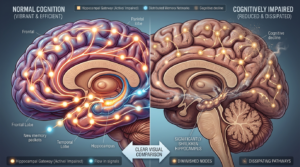
Can cognitive problems affect younger people?
Absolutely, although dementia itself remains predominantly a disease of later life.
A younger person complaining of “brain fog”, forgetfulness or poor concentration is statistically far more likely to have another explanation than Alzheimer’s disease.
Sleep deprivation is an obvious example. So are depression, anxiety, chronic stress, substance use, medication effects and nutritional deficiencies.
Then there is ADHD.
ADHD can produce difficulties with attention, working memory, organisation and executive function that superficially resemble cognitive decline. But there is an important difference.
ADHD is fundamentally a neurodevelopmental condition. Dementia is an acquired decline from a person’s previous cognitive ability.
Imagine two filing clerks.
In ADHD, the clerk may always have struggled to decide which papers deserve attention and where to put them.
In dementia, a previously efficient clerk gradually begins losing the filing system itself.
Intriguingly, research suggests there may nevertheless be some connection. A large cohort study involving more than 109,000 adults found that an adult ADHD diagnosis was associated with a significantly increased subsequent risk of dementia. A 2024 systematic review also concluded that ADHD warrants further investigation as a potential dementia risk factor.
But association is not causation. Shared genetics, cardiovascular risks, psychiatric illness, lifestyle factors, cognitive reserve and even diagnostic overlap may contribute.
ADHD does not mean that someone will develop dementia.
When does cognitive ageing begin?
There is no birthday on which the brain suddenly starts declining.
Some cognitive abilities, particularly processing speed, can gradually become less efficient surprisingly early in adulthood. Others, including vocabulary and accumulated knowledge, can remain remarkably resilient for decades.
Dementia is different.
Its incidence rises steeply with advancing age, particularly after 65, but dementia should never be dismissed as “normal ageing”.
Think of an older computer.
It may take slightly longer to find a file, but the file is still there.
That is ageing.
If files begin disappearing, familiar programs stop working, and everyday tasks become impossible, something else is happening.
Why do yesterday’s memories disappear before childhood memories?
One of the most fascinating features of Alzheimer’s disease is that someone may vividly remember a childhood holiday from 60 years ago yet forget what they ate for breakfast.
The explanation involves the hippocampus, a seahorse-shaped structure deep within the temporal lobes that is essential for forming and consolidating new memories.
Think of the hippocampus as the brain’s reception desk.
New experiences arrive there before being organised and gradually integrated into wider networks across the cerebral cortex.
In Alzheimer’s disease, structures involved in forming new episodic memories, including the hippocampal and entorhinal regions, are affected relatively early.
The receptionist therefore struggles to check in new guests.
Older memories, however, have already been distributed into networks elsewhere in the brain. They can therefore remain accessible much longer.
Eventually, as disease becomes more widespread, those older memories may also disappear.
Your brain is an energy-hungry organ
Although the adult brain represents only about 2% of body weight, it consumes roughly 20% of the body’s resting energy.
Its preferred everyday fuel is glucose.
But glucose is not its only possible fuel.
During prolonged fasting, starvation or carbohydrate restriction, the liver produces ketone bodies, which can cross the blood-brain barrier and supply neurons with energy.
This becomes particularly interesting in Alzheimer’s research because reduced cerebral glucose metabolism can appear early in the disease process. Researchers are consequently investigating whether ketones can provide an alternative energy source when brain glucose utilisation becomes impaired.
This does not, however, prove that everyone should adopt a ketogenic diet to prevent dementia. Clinical evidence remains developing, and dietary interventions need to be considered in the context of an individual’s overall health.
Is Alzheimer’s really “type 3 diabetes”?
You may have heard Alzheimer’s disease described as “type 3 diabetes.”
It is an intriguing scientific analogy but not an official medical diagnosis.
Researchers have discovered abnormalities in insulin signalling and glucose metabolism in Alzheimer’s brains. Diabetes itself is also an established dementia risk factor, and a 2024 meta-analysis reinforced the association between diabetes and dementia.
Imagine insulin as part of a signalling network telling cells how to manage incoming fuel.
When insulin signalling becomes impaired, neurons may experience metabolic stress. Oxidative stress, mitochondrial dysfunction, inflammation and abnormal protein processing can follow.
This is where sugar enters the conversation.
Chronically excessive energy intake, particularly within a diet dominated by refined carbohydrates and ultra-processed foods, can promote obesity, insulin resistance and type 2 diabetes. A large 2024 UK Biobank study involving more than 210,000 participants also found higher sugar intake was associated with greater subsequent dementia risk.
But it would be scientifically incorrect to say simply:
“Sugar causes Alzheimer’s.”
It doesn’t work that way.
Think instead of metabolic health as the soil in which the brain is growing. Persistent insulin resistance, hypertension, obesity, vascular damage and inflammation can make that soil progressively less hospitable.
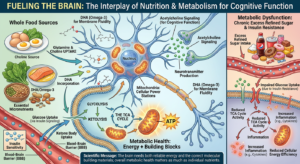
Feed the brain’s chemistry
Food is not merely calories. It supplies the raw materials from which brain cells build membranes, neurotransmitters, enzymes and signalling molecules.
Choline
Choline is required to produce acetylcholine, an important neurotransmitter involved in memory and attention. It is also used to make phosphatidylcholine, an important component of cell membranes.
Eggs are particularly rich dietary sources, with additional choline available from fish, meat, dairy, soybeans and other foods.
But while choline is biologically essential, that does not mean taking large choline supplements prevents Alzheimer’s disease. Human intervention evidence remains much less certain than the underlying biochemistry.
DHA and omega-3
The brain is extraordinarily rich in lipids, and DHA (docosahexaenoic acid) is an important structural omega-3 fatty acid in neuronal membranes.
Imagine the neuronal membrane as the flexible skin around a sophisticated communications centre. Its composition influences signalling and membrane function.
Oily fish such as sardines, salmon, herring and mackerel provide DHA and EPA.
Again, nutrition and supplementation should not be confused. Omega-3-rich dietary patterns are associated with health benefits, but clinical trials of omega-3 supplements in established Alzheimer’s disease have produced mixed or modest results.
L-carnitine
Carnitine helps transport long-chain fatty acids into mitochondria, the microscopic energy factories inside cells.
That makes it biologically interesting, but claims that acetyl-L-carnitine treats dementia should be approached cautiously. A Cochrane review found insufficient convincing evidence to recommend it routinely for dementia.
Biochemical plausibility is not the same thing as clinical proof.
Don’t forget the ordinary deficiencies
Sometimes sophisticated discussions about “brain optimisation” overlook basic medicine.
Vitamin B12 deficiency, for example, can produce neurological symptoms and cognitive impairment. In genuinely deficient patients, identifying and correcting it can be extremely important.
Folate and thiamine deficiencies can also damage neurological function. Iron, iodine, vitamin D and other nutrients have important roles in nervous system physiology, although supplementing people who are already nutritionally sufficient should not automatically be expected to improve cognition.
The principle is simple:
Correct deficiency rather than assuming more is always better.
Exercise: fertiliser for the brain
If there were a drug capable of improving cardiovascular health, insulin sensitivity, mood, muscle strength and possibly brain plasticity simultaneously, it would receive enormous attention.
We already have one.
It is called exercise.
Aerobic exercise brisk walking, cycling, swimming, running increases blood flow and triggers molecular adaptations throughout the body.
One particularly fascinating molecule is brain-derived neurotrophic factor, or BDNF.
Think of BDNF as part fertiliser, part maintenance engineer for neuronal networks. It supports neuronal survival, synaptic plasticity and learning.
A 2024 meta-analysis of 35 randomised controlled trials found exercise training significantly increased resting BDNF concentrations in older adults. Aerobic, resistance and combined exercise all showed benefits.
And don’t neglect muscle.
Skeletal muscle is not merely machinery for moving our bones. Contracting muscle acts almost like an endocrine organ, releasing signalling molecules called myokines that communicate with other tissues, including potentially the brain.
Resistance training also helps preserve strength, insulin sensitivity, bone health and functional independence.
In men, resistance exercise and maintaining healthy body composition may support the broader hormonal environment, but claims that muscle building prevents cognitive decline specifically by increasing testosterone should be treated cautiously. Testosterone participates in brain physiology, but the muscle-brain relationship is considerably more complex than a single hormone.
Sleep: the brain’s night shift
While you sleep, your brain is anything but inactive.
Sleep supports memory consolidation, metabolic regulation, immune function and cellular repair.
During deep slow-wave sleep, newly acquired information is reorganised and strengthened almost like the brain moving documents from today’s cluttered desktop into long-term storage.
There is also intense scientific interest in the glymphatic system, a fluid-transport system involved in clearing metabolic waste from brain tissue.
The popular description of sleep as the brain’s “dishwasher” is attractive but probably too simplistic. Recent experiments have challenged aspects of the idea that waste clearance simply accelerates during sleep, while newer human imaging continues to support the existence of organised brain-clearance pathways.
So, the science is evolving.
What is not controversial is that chronically inadequate or fragmented sleep is bad for cognitive performance and is associated with poorer long-term brain health.
Melatonin adds another layer. Beyond regulating circadian timing, melatonin has antioxidant and cell-signalling properties. Deep sleep is also associated with important hormonal and repair processes.
Sleep is therefore not dead time.
It is biological maintenance time.
Chronic stress: when the alarm never switches off
Short-term stress can sharpen attention.
Chronic stress is different.
Persistently activated stress systems expose the brain to repeated glucocorticoid signalling, including cortisol. The hippocampus, our crucial memory and learning structure, is particularly sensitive to chronic stress.
Animal research and human imaging studies associate prolonged severe stress with altered hippocampal structure and impaired memory-related function.
Imagine running a building’s emergency generator continuously.
It is excellent during a blackout.
Run it for months, however, and machinery designed for emergencies begins to wear down.
The brain was designed to experience stress.
It was not designed to live permanently inside the emergency.
Perhaps the biggest surprise: dementia prevention isn’t just about diet
The 2024 Lancet Commission identified 14 modifiable dementia risk factors across life:
lower education, hearing loss, high LDL cholesterol, depression, traumatic brain injury, physical inactivity, diabetes, smoking, hypertension, obesity, excessive alcohol, social isolation, air pollution and untreated visual loss.
Two are particularly easy to underestimate: hearing and vision.
A brain deprived of good sensory information receives a progressively poorer signal from the outside world. Hearing impairment can also encourage withdrawal from conversation and social contact.
Protecting cognition therefore means protecting the entire system supplying the brain: arteries, metabolism, muscles, senses, sleep and social environment.
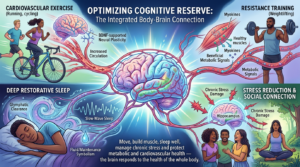
The bigger picture
There is no single “anti-dementia food”.
There is no supplement that can compensate for smoking, uncontrolled hypertension, inactivity, metabolic disease, chronic sleep deprivation and social isolation.
And there is no lifestyle capable of guaranteeing that somebody will never develop dementia.
Genes matter. Age matters. Chance matters. Neurodegenerative biology matters.
But lifestyle matters too.
The most useful mental picture may be to imagine your brain as a city.
Neurons are its citizens. Blood vessels are the roads and supply network. Glucose and ketones provide energy. Nutrients provide construction materials. Sleep runs maintenance. Exercise stimulates renovation. Muscles send messages from the suburbs. The hippocampus operates the new-records office. And social interaction keeps communication flowing between neighbourhoods.
Protecting one building while allowing the roads, power stations and communication networks to collapse will not preserve the city.
Brain health is a systems problem.
And that is perhaps the most empowering message emerging from modern neuroscience:
We cannot control everything about how our brain ages, but brain ageing is not entirely beyond our influence either.
The best time to protect an ageing brain may therefore not be when memory starts failing at 75.
It may be at 35, 45 or 55 — by moving, sleeping, learning, eating well, treating blood pressure and diabetes, maintaining muscle, protecting hearing and vision, staying socially connected and giving the brain reasons to remain adaptable.
We spend decades planning financially for retirement.
Perhaps we should also be investing in the organ we hope to enjoy it with.
If you found this discussion useful, you may be interested in my recently published book, “Your Metabolic Shift”, which explores these concepts in greater depth.
Frequently Asked Questions
Is forgetting names a sign of dementia?
Not necessarily. Occasional retrieval failures are common, particularly with fatigue, stress and ageing. Concern increases when memory problems become progressive and interfere with normal daily activities.
Can young people experience cognitive decline?
Yes. Cognitive symptoms can occur at any age, but in younger adults, causes such as poor sleep, stress, depression, ADHD, medications, alcohol, metabolic illness or nutritional deficiencies are generally much more likely than dementia.
Is ADHD an early form of dementia?
No. ADHD is a neurodevelopmental disorder, whereas dementia represents acquired deterioration from previous cognitive functioning. Some observational research has found an association between adult ADHD and later dementia, but this does not establish that ADHD causes dementia.
At what age does dementia usually begin?
Risk increases substantially after age 65 and rises further with advancing age. Dementia before 65 is termed young-onset dementia and is much less common.
Why does Alzheimer’s affect recent memories first?
The hippocampus and nearby medial temporal structures involved in forming new memories are affected relatively early. Older memories have already been consolidated across wider cortical networks and may therefore remain accessible longer.
Does eating sugar cause Alzheimer’s disease?
Not directly. “Type 3 diabetes” is a research concept rather than an official diagnosis. However, insulin resistance, type 2 diabetes, obesity and poor vascular health are associated with greater dementia risk, making long-term metabolic health highly relevant.
Can the brain use ketones instead of glucose?
Yes. Although glucose is normally its major fuel, the brain can utilise ketone bodies during fasting, prolonged carbohydrate restriction and other metabolic circumstances. Ketone-based interventions are being investigated in Alzheimer’s disease, but they are not an established cure.
What exercise is best for the brain?
Evidence supports regular aerobic activity, while resistance exercise offers complementary benefits through muscle preservation, metabolic health and possibly muscle-brain signalling. A combination is therefore sensible for most medically suitable adults.
Can supplements prevent dementia?
No supplement has been demonstrated to reliably prevent dementia in the general population. Correcting genuine nutritional deficiencies, particularly deficiencies such as vitamin B12, is important, but “more” of a nutrient is not necessarily better when nutritional status is already adequate.
What should I do if my memory is noticeably deteriorating?
Seek medical assessment rather than assuming it is normal ageing. Cognitive symptoms can sometimes have treatable contributors, including medication effects, sleep disorders, depression, thyroid dysfunction and nutritional deficiencies.
This article is intended for education and should not be used to diagnose or treat cognitive impairment. New, progressive or unexplained changes in memory, behaviour, concentration or everyday functioning warrant appropriate medical assessment.
References
- Livingston G, Huntley J, Liu KY, et al. Dementia prevention, intervention, and care: 2024 report of the Lancet standing Commission. Lancet. 2024;404(10452):572–628. doi:10.1016/S0140-6736(24)01296-0.
- Levine SZ, Rotstein A, Kodesh A, et al. Adult attention-deficit/hyperactivity disorder and the risk of dementia. JAMA Network Open. 2023;6(10):e2338088. doi:10.1001/jamanetworkopen.2023.38088.
- Carr RH, Eom GD, Brown EE. Attention-deficit/hyperactivity disorder as a potential risk factor for dementia and other neurocognitive disorders: a systematic review. Journal of Alzheimer’s Disease. 2024;98(3):773–792. doi:10.3233/JAD-230904.
- Ahlawat A, Walia V, Garg M. Brain insulin resistance mediated cognitive impairment and neurodegeneration: Type-3 diabetes or Alzheimer’s disease. 2024/2025. doi:10.1007/s13760-024-02706-7.
- de la Monte SM, Wands JR. Alzheimer’s disease is type 3 diabetes—evidence reviewed. Journal of Diabetes Science and Technology. 2008;2(6):1101–1113. doi:10.1177/193229680800200619.
- Albar NY, Hassaballa H, Shikh H, et al. The interaction between insulin resistance and Alzheimer’s disease: a review article. Postgraduate Medicine. 2024;136(4):377–395. doi:10.1080/00325481.2024.2360887.
- Cao F, Yang F, Li J, et al. The relationship between diabetes and the dementia risk: a meta-analysis. Diabetology & Metabolic Syndrome. 2024;16:101. doi:10.1186/s13098-024-01346-4.
- Associations of sugar intake, high-sugar dietary pattern, and the risk of dementia: a prospective cohort study of 210,832 participants. 2024. PubMed PMID: 39020335.
- Ye YC, et al. Intermittent fasting and Alzheimer’s disease—targeting ketone bodies as a potential strategy for brain energy rescue. Metabolic Brain Disease. 2024. PMID: 37823968.
- Exercise training alters resting brain-derived neurotrophic factor concentration in older adults: a systematic review with meta-analysis of randomized-controlled trials. 2024. PMID: 39674562.
- Calderon Martinez E, Saji SZ, Salazar Ore JV, et al. The effects of omega-3, DHA, EPA, Souvenaid® in Alzheimer’s disease: a systematic review and meta-analysis. Neuropsychopharmacology Reports. 2024;44(3):545–556. doi:10.1002/npr2.12455.
- Hudson SA, Tabet N. Acetyl-L-carnitine for dementia. Cochrane Database of Systematic Reviews. 2003;(2):CD003158. doi:10.1002/14651858.CD003158.
- Moore E, Mander A, Ames D, et al. Cognitive impairment and vitamin B12: a review. International Psychogeriatrics. 2012. PMID: 22221769.
- Sunwoo Y, Park J, Choi CY, et al. Risk of dementia and Alzheimer’s disease associated with antidiabetics: a Bayesian network meta-analysis. American Journal of Preventive Medicine. 2024;67(3):434–443. doi:10.1016/j.amepre.2024.04.014.