
Most people spend decades building a pension but neglect their vitality. Discover the Vitality Curve and learn how to protect your energy, independence, and quality of life as you age.
For thousands of years, humanity fought a single battle: how to live longer.
In 1900, the average life expectancy in the UK was around 50 years. Today, it exceeds 80 years.
We won. Yet something has gone terribly wrong.
Recent UK data show that healthy life expectancy has fallen to just 60.7 years for men and 60.9 years for women. In other words, the average Briton can expect to spend approximately two decades of life battling illness, disability, frailty, cognitive decline, and loss of independence.
We have become very good at extending lifespan.
We have been less successful at protecting vitality.
That is why I believe we need a new conversation.
Not about lifespan.
Not even about longevity.
But about vitality.
Because vitality is what makes life worth living.
What Is Vitality?
Vitality is your ability to do things and enjoy life.
It is:
- Having enough energy to enjoy life
- Walking confidently without fear of falling
- Climbing stairs without becoming breathless
- Travelling when you choose
- Playing with grandchildren
- Maintaining your independence
- Staying mentally sharp
- Continuing to contribute to society
Vitality is not simply being alive.
It is being fully engaged in life.
The opposite of vitality is not death.
The opposite of vitality is dependency.
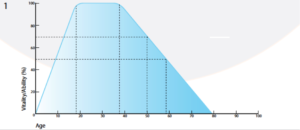
The Vitality Curve
Is something very close to my heart.
I found it helpful to explain vitality to my patients.
The horizontal axis represents age.
The vertical axis represents vitality.
Most people reach peak vitality between approximately 18 and 38 years of age.
This is when strength, resilience, recovery, physical performance, and mental sharpness are often at their highest.
There is a reason most professional athletes retire before the age of 40.
Even elite performance has a biological peak.
Consider two football legends.
Pelé and Diego Maradona.
Both were among the greatest players in history.
Both retired from professional football in their thirties.
Yet their later years looked very different.
Pelé remained active, engaged, and productive for decades after retirement.
Maradona developed severe metabolic problems, gained substantial weight, experienced multiple health challenges, and died at the age of 60.
Two extraordinary athletes.
Two very different vitality curves.
The difference was not football talent.
The difference was metabolic resilience.
Why Does Vitality Decline?
Most people assume vitality declines with age.
That is only partly true.
Much of the decline we associate with ageing is driven by three major factors:
Metabolic Dysfunction
- The body’s ability to produce and use energy becomes less efficient.
- Blood sugar regulation deteriorates.
- Inflammation increases.
- Recovery slows.
- Fat accumulates.
- Energy falls.
Muscle Loss
Muscle is one of the most important organs of longevity.
Without sufficient muscle:
- Strength declines
- Mobility declines
- Balance deteriorates
- Falls become more likely
- Independence becomes threatened
A Sedentary Lifestyle
Modern life encourages sitting.
The body was designed for movement.
When movement disappears, vitality often follows.
The Cliff Edge Events
Most vitality decline happens gradually.
However, some events can suddenly accelerate the process.
As a physician and geriatrician, I have seen this repeatedly.
A patient develops a chest infection.
Within days:
- Appetite disappears
- Strength collapses
- Mobility deteriorates
- Weight falls
The infection eventually resolves.
But the patient never fully recovers.
I have often seen patients lose more muscle and vitality during a couple of days’ illness than during the previous two years.
This is why vitality matters.
When your vitality reserve is high, you can absorb life’s shocks.
When it is low, even a relatively minor illness can become life-changing.
Think of vitality as a rechargeable battery.
A healthy person may begin with a battery that is 90% charged.
Someone with poor metabolic health may already be operating at 20%.
An infection can drain both batteries.
One recovers quickly.
The other may never fully recharge.
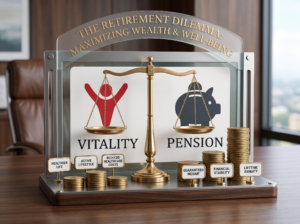
Muscle: Your Biological Pension
When people think about retirement, they think about financial assets.
Only a few think about biological assets.
Yet muscles may be one of the most valuable assets you will ever own.
Muscle is not just about appearance.
It is yours:
- Mobility
- Independence
- Metabolic health
- Longevity asset
In many ways, muscle behaves like a pension.
The earlier you invest, the larger the return.
The longer you neglect it, the harder it becomes to rebuild.
A person entering retirement with strong muscles enters with options.
A person entering retirement with severe muscle loss enters with limitations.
This is why strength training may be one of the most powerful anti-ageing interventions available.
Vitality Versus Pension
Your pension determines how much money you have in retirement. Your vitality determines whether you can enjoy it.
Many people spend 40 years building a financial pension while neglecting their vitality pension.
Imagine two retirees:
Person A
- Pension value: £2 million
- Type 2 diabetes
- Arthritis
- Poor mobility
- Breathlessness
- Multiple medications
- Unable to travel
Person B
- Modest pension
- Strong muscles
- Good mobility
- Sharp mind
- Active social life
- Independent at 85
Who is wealthier?
Most people instinctively choose Person B.
Because deep down we know something important.
Money creates opportunities. Vitality allows us to use them.
A luxury cruise means little if you cannot walk around the ship.
A beautiful home means little if you cannot climb the stairs.
Your financial pension determines how long your money lasts.
Your vitality pension determines how long your freedom lasts.
Think of Vitality as a Pension Account
Every day you either:
Make Deposits
- Strength training
- Walking
- Healthy eating
- Restful sleep
- Stress management
- Meaningful relationships
- Lifelong learning
Or
Make Withdrawals
- Sedentary lifestyle
- Ultra-processed foods
- Chronic stress
- Poor sleep
- Smoking
- Excess alcohol
- Social isolation
The problem is that most people don’t realise they are making withdrawals until the account is almost empty.
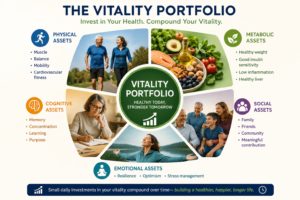
Build Your Vitality Portfolio
Just as a financial adviser recommends diversification, a vitality portfolio should include:
Physical Assets
- Muscle
- Balance
- Mobility
- Cardiovascular fitness
Metabolic Assets
- Healthy weight
- Good insulin sensitivity
- Low inflammation
- Healthy liver
Cognitive Assets
- Memory
- Concentration
- Learning
- Purpose
Social Assets
- Family
- Friends
- Community
- Meaningful contribution
Emotional Assets
- Resilience
- Optimism
- Stress management
These assets compound over time, just like money.
Start Early
The biggest mistake investors make is waiting too long to start.
The same applies to vitality.
Most people only become interested in health after:
- A heart attack
- Diabetes diagnosis
- Stroke
- Cancer
- Major surgery
But the best time to invest in vitality is when you still feel well.
Final Thought
We are living longer than any previous generation.
Yet many people spend the final decades of life battling disease, frailty, dependency, and loss of freedom.
Most people spend decades preparing financially for retirement.
Very few spend the same energy preparing biologically.
Yet your body and mind will ultimately decide whether retirement becomes the most rewarding years of your life or the most challenging.
So, start investing in your vitality today.
Because the goal is not simply to live longer.
The goal is to remain energetic, capable, independent, and fully engaged in life for as many years as possible.
That is the true meaning of longevity.
If you found this discussion useful, you may be interested in my recently published book, “Your Metabolic Shift”, which explores these concepts in greater depth.
Frequently Asked Questions
What is vitality?
Vitality is your ability to function physically, mentally, emotionally, and socially with energy, resilience, and independence.
What is the Vitality Curve?
The Vitality Curve is a simple model that illustrates how energy, strength, resilience, and independence typically change throughout life.
Is vitality decline inevitable?
Ageing is inevitable. Rapid vitality decline is often not. Many of the factors that influence vitality are modifiable.
At what age should I start monitoring vitality?
Ideally, from your forties or fifties, before major decline occurs.
What is the strongest predictor of future vitality?
Among the most powerful predictors are muscle strength, mobility, metabolic health, and physical activity levels.
Can vitality be improved after 60 or 70?
Absolutely. Research consistently shows that improvements in exercise, nutrition, sleep, and lifestyle can improve function even in later life.
What is biological age?
Biological age estimates how well your body functions relative to your chronological age.
Why should I care about vitality if I feel healthy today?
Because vitality is easier to preserve than to rebuild. Early action often produces the greatest long-term benefit.
This article is intended for educational purposes only and should not replace personalised medical advice. Readers with existing medical conditions should consult their healthcare professional before making significant dietary or lifestyle changes.
References
- Office for National Statistics. Healthy Life Expectancy, UK, 2022–2024. 2026.
- Health Foundation. Healthy Life Expectancy Trends in the UK: A Watershed Moment. 2026.
- Evans WJ. Frailty and Muscle Metabolism Dysregulation in the Elderly. Translational Research. 2010.
- Walston JD. Sarcopenia in Older Adults. Current Opinion in Rheumatology. 2012.
- Cleveland Clinic. Sarcopenia: Symptoms and Causes. 2026.
- Yang Y et al. Assessing the Impact of Frailty on Infection Risk in Older Adults. JMIR Public Health and Surveillance. 2024.
- International Clinical Practice Guidelines for Physical Frailty and Sarcopenia. Journal of Nutrition, Health & Aging.