Discover the science of recovery and adaptation, from restorative sleep and muscle repair to HRV, nutrition, mental recovery and long-term resilience.
You do not become stronger during the workout. You become stronger when you recover.
The same principle applies far beyond the gym.
During an ordinary day, we spend ourselves. Muscles contract, neurons fire, decisions accumulate, hormones fluctuate, and the immune system continuously patrols the body. Work deadlines, traffic, exercise, difficult conversations and even digestion impose small physiological demands.
Then evening arrives.
We eat. We drink. We slow down. Ideally, daylight gives way to darkness, stimulation falls, the nervous system changes gear, and we sleep.
It can look as though nothing is happening.
In reality, the night shift has arrived.
Fuel stores are replenished. Damaged molecules are repaired or recycled. Immune activity is reorganised. Neural networks are recalibrated. The brain enters physiological states that enhance clearance of metabolic byproducts. Tomorrow’s capacity is being built tonight.
That is why recovery belongs at the heart of our Metabolic, Vitality and Longevity series. Exercise, nutrition and metabolic challenge provide the stimulus. Recovery is where much of the adaptation to that stimulus takes place.
Think of Stephen Covey’s famous idea of sharpening the saw. A person can keep sawing harder and longer, but eventually a blunt blade makes every stroke less productive. Stopping to sharpen it may look like lost time. It’s what makes the next period of work possible and productive.
The human body operates on a similar principle.
Everyday recovery: returning the system towards balance
A healthy person continually moves away from and back towards physiological equilibrium.
During the working day, sympathetic nervous-system activity, cognitive demand, physical activity and metabolic requirements rise and fall. Recovery begins when those demands diminish, and the body has sufficient resources and time to restore itself.
Several factors determine how effectively that happens: sleep quantity and quality, circadian alignment, nutrition, hydration, physical fitness, age, training load, psychological stress, alcohol, illness and the opportunity to mentally disengage from work.
Sleep is particularly important.
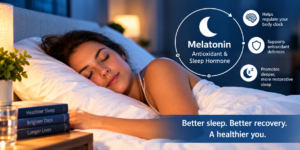
Our circadian clock coordinates physiology with the approximately 24-hour light-dark cycle. As darkness approaches under normal conditions, melatonin secretion rises, helping signal biological night. Melatonin is much more than just a sleep hormone: experimental research demonstrates direct and indirect antioxidant actions, including effects within mitochondria. Calling it the body’s single “master antioxidant” probably goes further than current clinical evidence allows, but its antioxidant biology is substantial. [1]
Deep non-REM sleep is another part of the story. During sleep, changes in cerebrospinal and interstitial fluid dynamics appear to help remove metabolites from the brain through pathways commonly described as the glymphatic system. Recent human evidence increasingly supports sleep-dependent brain clearance, although scientists are still working out exactly how important each mechanism is in humans. [2]
A useful mental picture is a city at night. Traffic falls, maintenance crews enter the streets, rubbish is collected, and essential infrastructure is repaired.
Sleep is not the brain switching off.
It is the maintenance window.
And this explains why recovery cannot always be replaced by another coffee, supplement or weekend lie-in. Biology works best when recovery is built into the rhythm of everyday life.
After exercise: repair, refuel and adapt
Now increase the stress.
Imagine finishing a marathon. Your legs hurt, glycogen stores have fallen, you’ve lost fluid and electrolytes, and thousands of muscle fibres have experienced microscopic structural stress.
For decades, much of the discomfort following hard exercise was blamed on “lactic acid”. We now know that story is too simple.
Lactate is not merely metabolic rubbish. It is a useful metabolic intermediate and fuel that tissues can transport and reuse. Elevated lactate after exercise usually falls relatively quickly and does not explain the muscle soreness that peaks a day or two later. Delayed-onset muscle soreness is more closely associated with the consequences of unfamiliar or damaging exercise, particularly eccentric loading.
That does not make gentle movement useless. Quite the opposite.
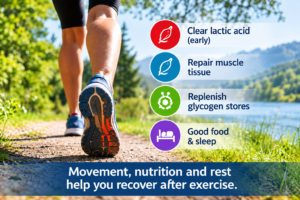
Easy walking, cycling, or other forms of active recovery increase circulation and can accelerate lactate removal in the early post-exercise period. Some athletes also report that gentle movement makes them feel better. But evidence that active recovery dramatically accelerates complete muscular recovery is mixed. Think of the post-marathon walk as keeping the transport network moving, rather than washing poison from the muscles.
Nutrition supplies the building materials.
Carbohydrate helps restore depleted muscle glycogen, the body’s readily accessible carbohydrate fuel store, while dietary protein supplies amino acids required for muscle protein synthesis and tissue remodelling. When another demanding session must occur within hours, rapid carbohydrate replacement becomes particularly important. [3]
Sleep then provides an environment in which endocrine, immune and tissue-repair processes can proceed. Inadequate sleep combined with high training load can interfere with recovery, while sleep extension may improve performance and some aspects of muscle recovery.
Why, then, can two people run the same marathon and recover very differently?
Because recovery capacity is individual. Training history, age, genetics, sleep, nutritional status, hydration, previous workload, psychological stress and illness all affect the response.
The same workload is not the same biological load for everyone.
Injury and illness: when recovery becomes reconstruction
A paper cut provides a remarkable demonstration of biological intelligence.
Within moments, haemostasis attempts to stop bleeding. Inflammation follows. Blood vessels and immune cells help contain threats and remove damaged tissue.
The familiar cardinal signs appear: redness, heat, swelling and pain—rubor, calor, tumour, and dolour.
Inflammation is therefore not automatically the enemy. In the correct amount and at the correct time, it is part of repair.
You can visualise the healing process as a damaged building site.
First, the area is secured. Then debris is removed. New structures are erected. Finally, the structure is strengthened and remodelled.
Biologically, these overlapping phases are generally described as haemostasis, inflammation, proliferation/repair, and maturation or remodelling. During proliferation, new extracellular matrix, blood vessels, and tissue form. During remodelling, collagen and other structures are reorganised and strengthened. [4]
Successful recovery does not necessarily mean returning every tissue to its exact previous state. It means restoring useful function and resilience as completely as circumstances permit.
Problems arise when the inflammatory phase becomes excessive or chronic, repair materials are inadequate, blood supply is poor, infection persists, or metabolic disease interferes with healing.
Again, recovery is an active biological process, not simply the passage of time.
Mental recovery: the brain needs an off-switch too
Physical fatigue is easy to understand because we can feel it in our muscles.
Cognitive fatigue is less visible.
After hours of decisions, screens, interruptions and emotional demands, we may experience brain fog, irritability, difficulty concentrating or the peculiar sensation of being exhausted while still unable to switch off.
One important concept is psychological detachment: temporarily disengaging mentally from work and its demands. Research links better detachment to less exhaustion, better sleep, and greater well-being, while high job stress can make detachment particularly difficult. [5]
Rumination creates a paradox: the brain keeps rehearsing the very stressor it should be recovering from.
Recovery requires competing signals.
Movement can change physiological state. Social connection can provide emotional regulation and perspective. Exposure to nature is associated with reductions in stress and improvements in aspects of wellbeing, although evidence strength varies across studies. Slow, controlled breathing can increase vagally mediated heart-rate variability, helping shift autonomic balance towards a calmer state. [6,7]
And sleep again becomes central.
The brain continuously produces metabolites. For example, astrocytes can take up extracellular glutamate and convert it into glutamine; lactate, amyloid-beta, and other compounds have their own clearance and metabolic pathways. Sleep appears to enhance several forms of brain housekeeping and metabolite clearance. [2]
So perhaps mental recovery is less like “emptying the mind” and more like allowing the brain’s night-time cleaning and filing systems to do their work.
Can we measure recovery?
This is where modern wearables become interesting—and where caution is necessary.
Resting heart rate can provide a useful clue. If your normal morning pulse is consistently higher than usual alongside fatigue, poor sleep or declining performance, something may be placing additional stress on the system.
Heart-rate variability, or HRV, adds another piece of information. Rather than measuring how fast the heart beats, HRV examines variation in the intervals between beats. It reflects, among other influences, autonomic nervous-system regulation.
In athletes, HRV trends and particular measures such as RMSSD can provide useful information about adaptation, stress, and recovery. But one reading should not become a verdict. HRV is influenced by sleep, alcohol, illness, training, psychological stress, measurement conditions and numerous individual factors. It is most useful when compared with your own baseline and trend, not somebody else’s number. [8]
Blood tests are similar.
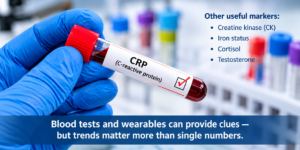
Creatine kinase (CK) may rise following muscle damage; C-reactive protein (CRP) can reflect systemic inflammation; urea, creatinine, iron status, cortisol, testosterone and other markers can sometimes provide useful context. But no single blood test currently tells us, “You need recovery today.”
Values vary greatly between individuals and with exercise, hydration, diet, sampling time and illness. Modern sports-medicine reviews therefore recommend interpreting biomarkers longitudinally and alongside symptoms, workload and performance rather than relying on isolated numbers. [9]
Sometimes the oldest dashboard remains one of the best: persistent soreness, unusual fatigue, disturbed sleep, declining motivation or performance, elevated resting heart rate, irritability, mood changes and withdrawal from normal activities.
The body often whispers before it shouts.
Recovery can also mean rebuilding a life
There is another dimension to recovery that extends beyond muscles and metabolism.
Recovery from addiction, psychological trauma or destructive behaviour requires adaptation too.
One influential framework, the Transtheoretical Model, describes movement through precontemplation, contemplation, preparation, action and maintenance. People may move forwards, backwards and through these stages more than once. [10]
The analogy with physical rehabilitation is striking.
Recovery is rarely a straight line.
A recovering muscle is progressively exposed to load. A recovering mind may progressively develop new routines, relationships, coping strategies and identities. In both cases, adaptation requires enough challenge to drive change but enough recovery capacity to absorb it.
The recovery equation
Across this Metabolic, Vitality and Longevity series, we keep returning to a fundamental biological principle:
Stress + recovery → adaptation.
Remove the stress entirely, and there may be little stimulus to improve.
Remove the recovery and stress simply accumulates.
The goal, therefore, is not a stress-free life. Nor is it endless optimisation. It is rhythm: effort followed by restoration; challenge followed by repair; loading followed by adaptation.
Protect regular sleep and circadian rhythm. Eat enough nutritious food to support the demands you place on your body. Rehydrate. Move gently after demanding activity when it feels appropriate. Build periods of psychological detachment into the day. Maintain relationships. Spend time outside. Use breathing or other relaxation practices when they help you change state. And watch trends in your body rather than becoming obsessed with individual measurements.

In summary
Recovery is not passive. During recovery, the body restores energy availability, repairs and remodels tissue, regulates immune activity, recalibrates the nervous system and prepares itself for future demands.
Sleep is one of its most powerful foundations. Nutrition provides fuel and building materials. Movement can support the transition from exertion to restoration. Mental detachment gives cognitive and emotional systems space to recover. Biomarkers and wearables can provide useful clues, but they work best as dashboard instruments rather than judges issuing a daily score.
Perhaps longevity, then, is not simply about how much stress the human organism can withstand.
It may depend just as much on how effectively it can recover, repair and adapt.
We spend enormous amounts of time learning how to work harder, train harder and push further.
Perhaps one of the most important skills for metabolic health, vitality and longevity is knowing when to put down the saw and sharpen it.
If you found this discussion useful, you may be interested in my recently published book, “Your Metabolic Shift”, which explores these concepts in greater depth.
Frequently Asked Questions
How much recovery does a healthy person need?
There is no universal recovery prescription. Sleep needs, workload, age, fitness, illness and psychological stress all matter. Persistent fatigue or declining performance despite adequate rest deserves attention, not just more effort.
Does lactic acid cause sore muscles the next day?
No. Lactate rises during demanding exercise but is rapidly transported and metabolised. It does not adequately explain delayed-onset muscle soreness 24–72 hours later.
Does walking after a marathon help recovery?
Gentle movement can increase circulation, accelerate early lactate clearance and may improve the subjective feeling of recovery. Evidence that it substantially speeds complete muscle repair is less convincing, so it should remain genuinely gentle.
Is melatonin an antioxidant as well as a sleep hormone?
Yes. Melatonin has direct and indirect antioxidant actions and interacts with mitochondrial antioxidant systems. Its best-established systemic role remains signalling biological night; calling it the single “master antioxidant” is better understood as an analogy than an established clinical designation.
Can HRV tell me whether I should exercise?
HRV can contribute useful information, especially when measured consistently and compared with your personal baseline. Combine it with sleep, soreness, mood, resting heart rate, illness symptoms, and performance rather than using it as a standalone traffic light.
Which blood test shows whether I am recovered?
No single test does. CK, CRP, blood count, iron indices and selected metabolic or hormonal markers may be useful in certain circumstances, but interpretation requires context. Persistent or unexplained fatigue should be medically assessed rather than attributed automatically to poor recovery.
This article is intended for educational purposes only and should not replace personalised medical advice. Readers with existing medical conditions should consult their healthcare professional before making significant dietary or lifestyle changes.
References
- Reiter RJ, Sharma RN, Manucha W, Rosales-Corral S, de Almieda Chuffa LG, Loh D, Luchetti F, Balduini W, Govitrapong P. Dysfunctional mitochondria in age-related neurodegeneration: Utility of melatonin as an antioxidant treatment. Ageing Research Reviews. 2024;101:102480. doi:10.1016/j.arr.2024.102480.
- Zare F, Shakhmurova G, Rizaev J, Smerat A, Abbood RS, Patil V, Kumar-Mishra M. Sleep-dependent clearance of brain metabolites via the glymphatic system: implications for Alzheimer’s pathophysiology. Brain and Behavior. 2026;16(4). doi:10.1002/brb3.71374.
- Naderi A, Rothschild JA, Santos HO, Hamidvand A, Koozehchian MS, Ghazzagh A, Berjisian E, Podlogar T. Nutritional strategies to improve post-exercise recovery and subsequent exercise performance: a narrative review. Sports Medicine. 2025;55(7):1559–1577. doi:10.1007/s40279-025-02213-6.
- Zhang Y, Guo D, Song L, Su G, Lin Z, Zhang H, Wan H, Zhang W, Zou Z. Inflammation and wound healing: a comprehensive overview of mechanisms, therapeutic strategies, and translational perspectives. Biomarker Research. 2026;14(1):75. doi:10.1186/s40364-026-00935-x.
- Wendsche J, Lohmann-Haislah A. A meta-analysis on antecedents and outcomes of detachment from work. Frontiers in Psychology. 2017;7:2072. doi:10.3389/fpsyg.2016.02072.
- Paredes-Céspedes DM, Vélez N, Parada-López A, et al. The effects of nature exposure therapies on stress, depression, and anxiety levels: a systematic review. European Journal of Investigation in Health, Psychology and Education. 2024;14(3):609–622. doi:10.3390/ejihpe14030040.
- Laborde S, Allen MS, Borges U, et al. Effects of voluntary slow breathing on heart rate and heart rate variability: a systematic review and a meta-analysis. Neuroscience & Biobehavioral Reviews. 2022;138:104711. doi:10.1016/j.neubiorev.2022.104711.
- Esco MR, Fields AD, Mohammadnabi MA, Kliszczewicz BM. Monitoring training adaptation and recovery status in athletes using heart rate variability via mobile devices: a narrative review. Sensors. 2026;26(1):3. doi:10.3390/s26010003.
- Haller N, Behringer M, Reichel T, Wahl P, Simon P, Krüger K, Zimmer P, Stöggl T. Blood-based biomarkers for managing workload in athletes: considerations and recommendations for evidence-based use of established biomarkers. Sports Medicine. 2023;53(7):1315–1333. doi:10.1007/s40279-023-01836-x.
- Prochaska JO, DiClemente CC, Norcross JC. In search of how people change: applications to addictive behaviours. American Psychologist. 1992;47(9):1102–1114. doi:10.1037/0003-066X.47.9.1102.