
Discover what VO2 max measures, why aerobic fitness matters for longevity, how VO2 max changes with age, and how exercise, breathing and technology can improve it.
Imagine two people climbing the same flight of stairs.
One reaches the top barely noticing the effort. The other’s heart races, breathing is rapid, and the legs burn.
The staircase is identical. The difference is physiological reserve.
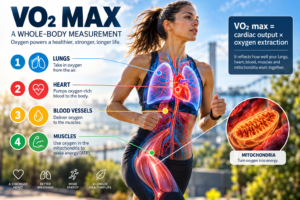
How effectively can the lungs bring oxygen into the body? How much blood can the heart pump with each beat? How efficiently can blood vessels deliver oxygen? And, finally, how effectively can skeletal muscle extract that oxygen and use it inside its mitochondria to manufacture energy?
One measurement brings much of this remarkable biological supply chain together:
VO₂ max.
Although the term originated in exercise physiology, VO₂ max may tell us something bigger than how quickly we can cycle or run.
It may provide a window into vitality, functional reserve and longevity.
What exactly is VO₂ max?
VO₂ means oxygen consumption.
VO₂ max is the maximum amount of oxygen the body can take up and utilise during progressively harder exercise. It is commonly expressed as:
millilitres of oxygen per kilogram of body weight per minute — mL/kg/min.
Think of oxygen delivery as a logistics network.
The lungs are the loading terminal.
The heart is the central pump.
The blood and circulation are the transport network.
The muscles are the customers.
And the mitochondria inside those muscles are the factories that use oxygen to help produce ATP—the body’s usable energy currency.
VO₂ max therefore isn’t really a “lung test.”
It is an integrated stress test of an entire biological system.
That distinction matters.
Someone can have perfectly respectable lungs yet poor aerobic capacity because cardiac output is limited, muscle mass is low, mitochondrial conditioning is poor, or they have simply become deconditioned.
Conversely, restricted chest movement does not automatically mean VO₂ max must be severely impaired. Older research in ankylosing spondylitis, for example, found relationships between chest expansion and vital capacity, but physically active patients could retain surprisingly good exercise capacity despite substantial restriction of spinal and chest-wall movement.
Aerobic capacity, VO₂ peak and VO₂ max: are they the same?
Aerobic capacity is the broader concept: the body’s ability to generate energy using oxygen.
VO₂ max is its most recognised laboratory measurement. Strictly speaking, true VO₂ max requires evidence that oxygen consumption has plateaued even as exercise workload continues to increase.
In clinical testing, that plateau is not always demonstrated. Consequently, VO₂ peak, the highest oxygen consumption achieved during the test, is often the more accurate term.
During cardiopulmonary exercise testing (CPET), we can measure much more than VO₂. We measure ventilation (VE), oxygen uptake (VO₂), carbon dioxide production (VCO₂), heart-rate responses and other variables.
The VE/VCO₂ slope, for example, tells us how much ventilation is required to eliminate carbon dioxide and provides information about ventilatory efficiency.
The RER VCO₂ divided by VO₂) also helps us understand metabolism and whether somebody has reached a genuinely high exercise intensity.
Why should a longevity clinic care about VO₂ max?
Because cardiorespiratory fitness is remarkably strongly associated with health outcomes.
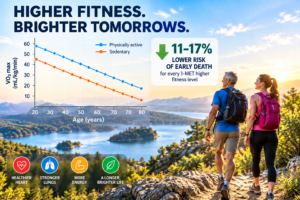
An overview encompassing more than 20.9 million observations found that high versus low cardiorespiratory fitness was associated with substantially lower all-cause mortality. Every 1-MET increase in fitness was associated across meta-analyses with approximately an 11–17% lower risk of all-cause mortality.
In another study of more than 750,000 people, mortality progressively declined as cardiorespiratory fitness increased, across age, sex and racial groups.
Importantly, these are largely observational associations. They do not prove that increasing a person’s VO₂ max by a particular number will automatically add a predetermined number of years to life.
But they tell us something powerful:
Fitness is not merely about sport. It is physiological reserve.
That reserve becomes particularly important during illness, surgery, ageing and periods of inactivity.
The equation behind the story: heart, blood and muscle
One of the simplest ways to understand VO₂ is the Fick principle:
VO₂ = cardiac output × oxygen extracted from the blood by the tissues.
And:
Cardiac output = heart rate × stroke volume.
Stroke volume is the amount of blood ejected by the heart with each beat.
Training can increase stroke volume. The trained heart therefore does not necessarily have to beat as frequently to deliver the same cardiac output at rest or during a given submaximal workload.
Imagine two pumps.
One moves 60 mL with every stroke, and another moves 90 mL.
The second can deliver the same volume using fewer strokes.
Endurance training is also associated with autonomic adaptation, including greater parasympathetic influence at rest. Together, these adaptations help explain why a fit person’s resting heart rate frequently falls.
Is a resting heart rate of 40 healthy? What about 30?
A resting heart rate in the 40s can be entirely physiological in a well-trained, asymptomatic athlete.
But lower is not endlessly better.
Current AHA/ACC guidance considers asymptomatic sinus bradycardia of 30 beats/minute or above while awake a normal training adaptation in competitive athletes. A waking heart rate below 30, or bradycardia associated with dizziness, fainting, unusual fatigue, exercise intolerance, chest symptoms or abnormal conduction findings, deserves medical evaluation.
So, a heart rate of 40 in a highly trained, asymptomatic person is very different from a heart rate of 40 in someone who is dizzy and exhausted.
The number needs context.
Tidal volume: breathing deeper rather than simply faster
The cardiovascular system has stroke volume.
The respiratory system has something conceptually similar: tidal volume, the volume of air moved during an ordinary breath.
As exercise intensity rises, ventilation initially increases substantially by increasing tidal volume, followed increasingly by breathing frequency.
This provides an interesting analogy with childhood breathing.
Babies characteristically show prominent abdominal movement because of their anatomy, highly compliant chest wall and reliance on the diaphragm. Adults often display a different pattern. Stress can certainly alter breathing, producing faster, shallower or irregular ventilation, but we should be careful not to label all upper-chest breathing as pathological or assume that “belly breathing” itself raises VO₂ max.
Respiratory mechanics matter, but VO₂ max is determined by the entire oxygen-delivery-and-utilisation system.
Do respiratory muscles, posture and spinal mobility matter?
They can—but the evidence needs nuance.
The diaphragm and accessory respiratory muscles are skeletal muscles. They can fatigue, and respiratory muscle training can increase inspiratory muscle strength. Meta-analyses in athletes suggest respiratory muscle training can improve some performance measures, although improvements in respiratory strength do not consistently translate into increases in VO₂ max.
Likewise, severe kyphosis, inflammatory spinal disease or restricted rib-cage mechanics can reduce lung volumes and increase the mechanical work of breathing. But VO₂ max may remain relatively well preserved when cardiovascular and peripheral muscular conditioning is good.
This is an important longevity lesson: posture, respiratory muscle function and thoracic mobility are parts of the system—but they are not the whole system.
What about mucus, phlegm and exercise-induced asthma?
This requires another important distinction.
Mucus primarily causes problems when excessive secretions or airway inflammation narrow or obstruct conducting airways. That can increase airway resistance and the work of breathing.
Exercise-induced bronchoconstriction is different again. During intense exercise, the respiratory tract must condition large volumes of relatively cool, dry air. Water loss from airway surfaces can trigger inflammatory mediators and airway smooth-muscle contraction in susceptible people, narrowing the airways.
Mucus in the larger airways therefore does not normally “coat the alveoli” and directly prevent oxygen absorption. Gas transfer occurs across the extraordinarily thin alveolar-capillary membrane. Diseases involving alveoli or the pulmonary interstitium can impair that exchange directly.
Some people notice increased coughing and secretion clearance when returning to exercise after inactivity. Increased airflow, deeper ventilation and movement can mobilise airway secretions.
Persistent or recurrent phlegm, wheeze, breathlessness, exercise-associated cough or falling oxygen saturation, however, deserves proper respiratory assessment rather than being assumed to represent simple deconditioning.
What happens when an elite athlete stops training?
The beautifully adapted system begins to reverse.
Plasma volume falls. Stroke volume decreases. At a given workload, the heart may need to beat faster. Muscle oxidative enzymes and mitochondrial adaptations diminish. Peripheral oxygen extraction becomes less efficient, and VO₂ max falls.
In other words, the athlete has not “lost their lungs.”
They have lost some of the coordinated adaptations throughout the oxygen transport system.
The encouraging part is that this system is highly trainable.
VO₂ max and ageing
VO₂ max generally declines with age.
Maximum heart rate falls, cardiac and vascular reserve change, muscle mass tends to decrease, mitochondrial and oxidative capacity can deteriorate, and inactivity can accelerate all these changes.
But ageing and deconditioning are not synonymous.
Master’s athletes provide an extraordinary natural experiment. Lifelong endurance exercise cannot completely prevent the age-related decline in VO₂ max, but it can substantially preserve aerobic capacity, leaving older athletes far fitter than sedentary peers of the same age.
A centenarian cyclist has even been reported with a VO₂ max around 35 mL/kg/min—a remarkable physiological reserve at that age.
At the other extreme, exceptionally trained young endurance athletes can approach or exceed 90 mL/kg/min.
The lesson isn’t that we should all become Olympic endurance athletes.
It is that our trajectory is modifiable.
Muscles, nerves and the brain
VO₂ max is deeply connected to skeletal muscle.
Muscle needs capillaries to deliver oxygen and mitochondria to use it. Endurance training increases mitochondrial machinery, capillary supply and oxidative capacity.
The relationship extends to the brain. Higher cardiorespiratory fitness has been associated with differences in cerebral oxygenation, and contemporary research increasingly links exercise-induced improvements in cardiorespiratory and muscular fitness with cognitive and brain-health outcomes.
Again, VO₂ max should not be mistaken for a direct “brain-health test.”
Rather, it marks a physiological ecosystem that also supports brain health.
How can we improve VO₂ max?
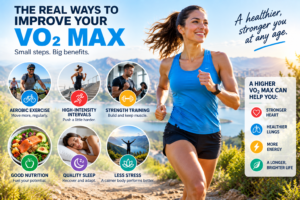
For most people, the most powerful technology remains remarkably inexpensive: regular movement followed by progressive overload.
A sensible programme combines frequent moderate aerobic activity walking briskly, cycling, swimming, rowing or similar with appropriately prescribed higher-intensity intervals and resistance training.
High-intensity interval training can be particularly effective for increasing VO₂ max, although the correct intensity depends on age, baseline fitness, cardiovascular risk, medication and medical history. Recent evidence in athletes continues to show substantial VO₂-max improvements from appropriately structured interval training.
Sleep, recovery, adequate nutrition, correction of iron deficiency where present, healthy body composition, smoking cessation and management of cardiovascular or respiratory disease all influence the machinery surrounding aerobic performance.
Selected individuals may also benefit from inspiratory-muscle training.
Technology can help us measure progress, but it cannot replace the physiology that creates it.
What about smartwatches?
Wearables from companies such as Garmin, Apple, Polar, and others can estimate VO₂ max or cardiorespiratory fitness.
They generally do not directly measure respiratory gases.
Instead, algorithms estimate fitness from combinations of heart rate, pace or power, movement, demographic information and previous exercise responses.
Systematic reviews suggest exercise-based wearable algorithms can provide useful VO₂-max estimates, particularly for following trends, but individual error can be substantial compared with laboratory measurement.
Think of a wearable as a weather forecast.
CPET is closer to putting instruments outside and measuring the weather.
Both can be useful, but they are not interchangeable.
Should VO₂ testing be available in a metabolic clinic?
I believe there is a compelling case for incorporating properly governed CPET/cardiorespiratory fitness assessment into selected metabolic and longevity programmes.
Not everybody needs maximal CPET.
It is particularly informative when we want to quantify baseline cardiorespiratory fitness; investigate otherwise unexplained exercise intolerance or exertional breathlessness; distinguish cardiovascular, respiratory, muscular and deconditioning limitations; establish personalised exercise zones; monitor meaningful changes following an intervention; or quantify physiological reserve in selected patients.
Patients with obesity, metabolic syndrome or type 2 diabetes may particularly benefit from objective assessment of fitness when the result will alter exercise prescription or clinical management.
But select tests based on medical history and risk. Someone with unstable cardiovascular disease, significant uncontrolled symptoms or other contraindications should not simply be put onto a treadmill for a maximal wellness test.
This is where a metabolic clinic can add something a smartwatch cannot: interpretation.
The question isn’t simply, “What is your VO₂ max?”
It is: What is it, and what part of the system can we improve?

The vitality perspective
Perhaps VO₂ max is best understood as the size of your physiological engine.
You rarely drive at maximum power.
But the engine’s size and condition determine how effortlessly you can handle hills.
Ageing brings more hills: infection, surgery, periods of inactivity, metabolic disease, muscle loss, and eventually the physical demands of ordinary life.
A person with greater physiological reserve has further to fall before everyday activities become exhausting.
That is why VO₂ max belongs in a conversation about longevity.
Not because everyone needs an elite athlete’s number.
But because maintaining the ability to transport and use oxygen is one of the foundations of remaining physically capable as we age.
The objective is not simply lifespan.
It is preserving enough reserve to keep climbing the stairs.
And still having something left in the tank when you reach the top.
If you found this discussion useful, you may be interested in my recently published book, “Your Metabolic Shift”, which explores these concepts in greater depth.
Frequently Asked Questions (FAQ)
Does everyone need a VO₂-max test?
No. Regular physical activity is beneficial whether you know your VO₂ max or not. Testing becomes valuable when you need a precise baseline, a personalised training prescription, an investigation of exercise limitation, or objective longitudinal measurement to guide management.
Is VO₂ max only for athletes?
No. Athletes popularised the measurement, but cardiorespiratory fitness is strongly associated with health and longevity throughout the general population.
What is the best way to measure it?
Direct measurement during appropriately supervised CPET using analysis of inhaled and exhaled gases is the reference approach. Wearables provide estimates rather than equivalent laboratory measurements.
Does VO₂ max decrease with age?
Generally, yes. However, lifelong physical activity can substantially attenuate the decline and preserve much greater functional reserve.
Can breathing exercises increase VO₂ max?
Breathing and inspiratory-muscle training can improve respiratory muscle strength and sometimes exercise performance, but breathing exercises alone should not be presented as a reliable substitute for cardiovascular and muscular conditioning.
Does a low resting heart rate mean I am very fit?
It can, particularly in endurance-trained people, but context matters. An asymptomatic waking rate of 30 bpm or above can occur as a physiological adaptation to athletic training. Rates below 30 while awake, symptoms or abnormal conduction findings warrant medical evaluation.
Can phlegm lower exercise capacity?
Excessive secretions can increase airway resistance if they obstruct conducting airways. Persistent phlegm, wheeze or exercise-associated breathlessness should be investigated rather than assumed to represent poor fitness.
What should I track: VO₂ max or resting heart rate?
They answer different questions. Resting heart rate reflects aspects of cardiovascular and autonomic adaptation; VO₂ max or VO₂ peak assesses integrated cardiorespiratory fitness. Trends in both can be informative.
This article is intended for educational purposes only and should not replace personalised medical advice. Readers with existing medical conditions should consult their healthcare professional before making significant dietary or lifestyle changes.
References
- Kokkinos P, Faselis C, Samuel IBH, et al. Cardiorespiratory Fitness and Mortality Risk Across the Spectra of Age, Race, and Sex. Journal of the American College of Cardiology. 2022;80(6):598–609.
- Lang JJ, Prince SA, Merucci K, et al. Cardiorespiratory fitness is a strong and consistent predictor of morbidity and mortality among adults: an overview of meta-analyses representing over 20.9 million observations from 199 unique cohort studies. British Journal of Sports Medicine. 2024.
- Kokkinos P, Faselis C, Samuel IBH, et al. Changes in Cardiorespiratory Fitness and Survival in Patients With or Without Cardiovascular Disease. Journal of the American College of Cardiology. 2023.
- Kaminsky LA, Arena R, Ellingsen Ø, et al. Cardiorespiratory fitness and cardiovascular disease—the past, present, and future. Progress in Cardiovascular Diseases. 2019;62:86–93.
- Radtke T, Crook S, Kaltsakas G, et al. ERS statement on standardisation of cardiopulmonary exercise testing in chronic lung diseases. European Respiratory Review. 2019;28:180101. doi:10.1183/16000617.0101-2018.
- Letnes JM, Dalen H, Vesterbekkmo EK, Wisløff U, Nes BM. Peak oxygen uptake and incident coronary heart disease in a healthy population: the HUNT Fitness Study. European Heart Journal. 2019;40:1633–1639.
- Burtscher J, Strasser B, Burtscher M, Millet GP. The impact of training on the loss of cardiorespiratory fitness in aging masters endurance athletes. International Journal of Environmental Research and Public Health. 2022.
- Valenzuela PL, Castillo-García A, Morales JS, et al. Lifelong Endurance Exercise as a Countermeasure Against Age-Related VO₂max Decline: Physiological Overview and Insights from Masters Athletes. Sports Medicine. 2020;50:703–716.
- Karsten M, Ribeiro GS, Esquivel MS, Matte DL. The effects of inspiratory muscle training with linear workload devices on the sports performance and cardiopulmonary function of athletes: a systematic review and meta-analysis. Physical Therapy in Sport. 2018;34:92–104. doi:10.1016/j.ptsp.2018.09.004.
- Gao X, Zheng Z. Effects of inspiratory or respiratory muscle training on respiratory function, perceived exertion, and exercise or functional performance in team-sport athletes: a systematic review and meta-analysis. BMC Sports Science, Medicine and Rehabilitation. 2026.
- Fisher LR, Cawley MID, Holgate ST. Relation between chest expansion, pulmonary function, and exercise tolerance in patients with ankylosing spondylitis. Annals of the Rheumatic Diseases. 1990;49:921–925.
- Hallstrand TS. Exercise-induced bronchoconstriction. Annals of Allergy, Asthma & Immunology. 2013;110:447–451.
- Düking P, Fuss FK, Holmberg HC, Sperlich B. Recommendations for assessment of the reliability, sensitivity, and validity of data provided by wearable sensors designed for monitoring physical activity. JMIR mHealth and uHealth. 2018.
- Molina-Garcia P, Notbohm HL, Schumann M, et al. Validity of estimating maximal oxygen consumption by consumer wearables: a systematic review with meta-analysis and expert statement of the INTERLIVE Network. Sports Medicine. 2022;52:1577–1597.
- American Heart Association/American College of Cardiology. Clinical Considerations for Competitive Sports Participation for Athletes With Cardiovascular Abnormalities: A Scientific Statement. Journal of the American College of Cardiology. 2025.
- Torma F, Gombos Z, Jokai M, et al. The roles of cardiorespiratory fitness and exercise in brain health and cerebral oxygenation. Evidence reviewed in contemporary systematic literature on cardiorespiratory fitness, cerebral oxygenation and cognition.
- Clausen JSR, Marott JL, Holtermann A, Gyntelberg F, Jensen MT. Midlife cardiorespiratory fitness and the long-term risk of mortality: 46 years of follow-up. Journal of the American College of Cardiology. 2018;72:987–995.