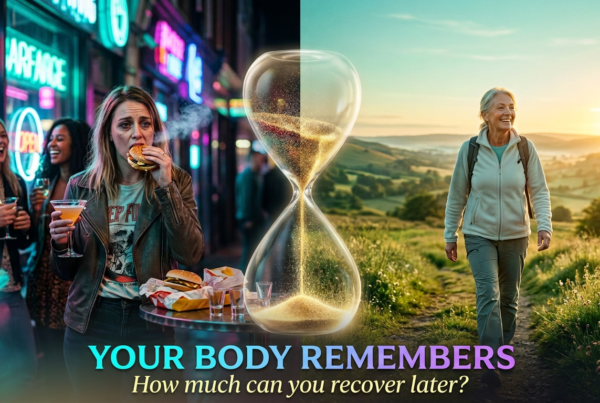
What is inflammaging? Discover how senescent cells, gut health, mitochondria, stress, muscle and immune ageing drive chronic inflammation and what may help.
Imagine waking one morning to discover that your home’s smoke alarm has become too sensitive.
It still performs its essential job. But now it sounds when you make toast. It occasionally wakes you in the middle of the night. And, strangely, some smoke detectors have started malfunctioning and triggering their neighbours.
Something similar can happen to our immune system as we grow older.
Inflammation saves lives. It fights infection, repairs injuries and helps remove damaged cells. Without it, a minor cut or infection could become dangerous.
But with age, something changes.
The inflammatory response may no longer switch off completely. Instead of a fire lit when danger appears and extinguished when the job is done, glowing embers remain.
Scientists call this inflammaging: the persistent, low-grade inflammatory state associated with ageing.
And those embers may matter far beyond aching joints. They connect several processes that determine how we age: senescent cells, immune ageing, mitochondrial damage, gut health, declining muscle, metabolic health, sleep, stress and nutrition.
For The Vitality Longevity Project, this raises an important possibility. Perhaps healthy longevity isn’t simply about preventing disease or slowing biological ageing. It is also about preserving the body’s ability to respond, repair and return to equilibrium.
The cells that retire but refuse to leave
One source of inflammaging is the senescent cell.
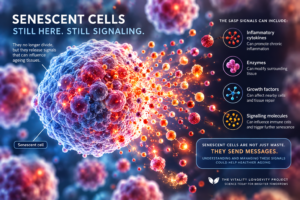
Cells normally work, divide, repair themselves, and eventually die or are removed. But damaged or stressed cells can enter senescence: they permanently stop dividing but remain alive.
Imagine employees who have retired but continue occupying their desks.
Senescence itself isn’t bad. It helps prevent damaged cells from becoming cancerous and plays useful roles in wound healing and development.
Trouble starts when senescent cells accumulate.
Many develop the senescence-associated secretory phenotype (SASP), releasing inflammatory cytokines, chemokines, enzymes and growth factors.
So senescent cells don’t simply release “toxins”. They can alter surrounding tissue, disturb regeneration, attract immune cells and influence neighbouring cells — sometimes encouraging further senescence.
Our immune system normally helps remove them. But as immunity itself ages, this surveillance becomes less effective. Senescent cells accumulate, inflammation increases, further cellular damage occurs, and the ageing immune system becomes less able to clear the consequences.
A biological vicious circle has begun.
Is senescent-cell accumulation inevitable?
To some extent, senescent cells increase with age, but people do not accumulate them at the same rate.
Smoking, obesity, metabolic dysfunction, inactivity, poor sleep, chronic infection and repeated cellular stress can all contribute to conditions favouring inflammation and senescence.
Exercise pushes several of these processes in the opposite direction.
It improves insulin sensitivity, mitochondrial function and body composition. Contracting muscles also release signalling molecules called myokines, or more broadly exerkines, which communicate with other organs and influence inflammatory and metabolic pathways.
This makes age-related muscle loss particularly important.
Sarcopenia is associated with chronic inflammation, metabolic dysfunction and mitochondrial problems. And the relationship works both ways: inflammation contributes to muscle loss, while losing metabolically active muscle may worsen metabolic and inflammatory regulation.
Muscle isn’t simply machinery for movement. It is part of our anti-ageing communication network.
Mitochondria: when the power stations send distress signals
Inside almost every cell are mitochondria, usually described as our cellular power stations.
But these power stations contain their own DNA.
With ageing and cellular stress, mitochondria can become damaged. If mitochondrial DNA escapes into areas where it shouldn’t be, the immune system may interpret it as an invasion.
One important detector is the cGAS–STING pathway, which can trigger inflammation.
Cells have a recycling process called mitophagy to dismantle damaged mitochondria. When this quality-control system becomes less effective, dysfunctional mitochondria and inflammatory signals may accumulate.
This suggests another way of thinking about ageing.
It isn’t simply the accumulation of damage. It is also the gradual deterioration of maintenance, recycling and waste disposal.
Supporting mitochondrial health therefore brings us back to familiar interventions: physical activity, metabolic health, sleep, avoiding smoking and providing adequate nutrition rather than searching for one miraculous “mitochondrial” supplement.

And then there is the gut
Our intestinal lining performs an extraordinary balancing act.
It must absorb nutrients while keeping trillions of microorganisms and their components on the other side.
Imagine a sophisticated border checkpoint only one cell thick.
When that barrier is disrupted, bacterial products such as lipopolysaccharide (LPS) may gain greater access to tissues and circulation, activating the immune system. Age-related changes in the microbiome, intestinal barrier and immunity may therefore contribute to systemic inflammation.
Diet can influence this ecosystem. A Western-style diet dominated by ultra-processed foods and low in fibre creates a very different environment from one rich in vegetables, fruits, legumes, nuts, whole grains and other fibre-rich foods.
But “leaky gut” shouldn’t become an explanation for every symptom.
Coeliac disease is a clear example where gluten causes immune-mediated intestinal damage in genetically susceptible people. Wheat allergy and other gastrointestinal disorders are different conditions requiring appropriate diagnosis.
Nor should everyone automatically remove gluten or dairy.
Gut dysbiosis may also contribute to inflammation, but our microbiomes are remarkably individual.
Which leads to another question.
Do we all need the same anti-inflammatory diet?
Probably not exactly.
Population research gives us strong foundations: diets rich in minimally processed plants, fibre, unsaturated fats and polyphenol-rich foods, and lower in highly processed foods, are consistently associated with better metabolic and inflammatory health.
Yet people can respond very differently to the same meal.
The PREDICT studies demonstrated substantial individual differences in post-meal glucose, insulin and triglyceride responses, alongside major variation in gut microbiomes.
This doesn’t mean nutrition is entirely individual and that general dietary advice is useless.
It means we should start with the map, then personalise the route.
Future anti-inflammatory nutrition may therefore combine evidence-based dietary patterns with individual metabolic responses, symptoms, microbiome characteristics and properly diagnosed allergies or intolerances.
That is precision nutrition without abandoning nutritional common sense.
Can we remove senescent cells?
This is one of longevity medicine’s most exciting and most overhyped questions.
Calorie restriction and fasting influence autophagy, nutrient-sensing pathways, metabolism and cellular stress responses associated with ageing. Human research suggests nutritional interventions can modify some markers associated with cellular senescence.
But altering biomarkers is not the same as proving that fasting clears senescent cells from human tissues.
The same caution applies to stem-cell therapies. Regenerative medicine is enormously promising, but stem cells are not currently an established treatment for clearing senescent cells in healthy people.
Researchers are also investigating senolytics, drugs designed to kill senescent cells selectively, and senomorphics, which attempt to suppress their harmful behaviour.
They may eventually become important longevity therapies.
For now, the interventions supported by stronger human evidence are far less exotic: exercise, healthy body composition, good nutrition, not smoking, adequate sleep, metabolic health and preservation of muscle.
Stress, ageing and the leaky gut question
Do older people become more vulnerable to stress simply because they’ve had longer to accumulate things to worry about?
Life experience can certainly bring bereavement, illness, caring responsibilities, loneliness, financial concerns and loss of independence.
But biology also changes.
Chronic stress affects cortisol signalling, sleep, glucose metabolism, immune function and the gut-brain axis. Stress may influence intestinal permeability through neural, immune and hormonal pathways, although human evidence that everyday psychological stress routinely causes clinically significant “leaky gut” remains less certain than laboratory and animal studies suggest.
More importantly, ageing may reduce resilience, our ability to absorb a disturbance and return rapidly to equilibrium.
Think of a young tree and an older, less flexible tree facing the same storm.
The storm doesn’t necessarily need to become stronger for its effects to become greater.
Managing stress in later life is therefore less about eliminating stress than strengthening recovery through sleep, exercise, social connection, purpose, relaxation and psychological support where appropriate.

The ageing immune system: weaker yet noisier
Here lies one of the great paradoxes of ageing.
Our immune system can become simultaneously less effective and more inflammatory.
This process, called immunosenescence, involves changes across innate and adaptive immunity. The thymus shrinks, immune-cell populations change, responses to new infections and vaccines may weaken, and surveillance of damaged or senescent cells becomes less efficient.
Yet background inflammatory signalling can rise.
Imagine an ageing security service becoming worse at catching intruders while triggering more false alarms.
Immunosenescence and inflammaging can therefore reinforce each other.
We cannot currently reverse immune ageing completely, but exercise, adequate nutrition and protein, preserving muscle, good sleep, vaccination, avoiding smoking and controlling metabolic disease can all support immune resilience.
Can we measure inflammaging?
There is currently no single inflammaging test.
High-sensitivity C-reactive protein (hs-CRP) is inexpensive and useful for detecting low-grade systemic inflammation, although it is non-specific. IL-6 and TNF-α are scientifically interesting but harder to interpret routinely.
For The Vitality Longevity Project, a dashboard rather than a single number may prove more useful.
That could combine repeated hs-CRP measurements with glucose control, lipids, blood pressure, waist circumference and body composition, alongside muscle strength and physical fitness.
Trends matter more than snapshots. A raised CRP during an infection means something quite different from persistently elevated hs-CRP when someone is otherwise well.
Future proteomic, metabolomic and immune-signature testing may make this much more sophisticated.
Can our genes or biological age predict inflammaging?
Genetics certainly influences inflammatory, metabolic and immune responses. Some inherited variants can increase susceptibility to inflammatory, autoimmune or cardiometabolic disease.
But genes influence the landscape; they don’t necessarily dictate the journey.
Telomere length is also biologically fascinating, but it is not a personal inflammaging meter. Measurements vary, and interpretation at the individual level remains difficult.
Epigenetic clocks, based on patterns of DNA methylation, offer more sophisticated estimates of biological ageing. Newer versions correlate with health outcomes, immune characteristics and mortality risk.
They are promising research tools, but they are not yet a definitive clinical speedometer showing exactly how quickly one person is ageing.
Within The Vitality Longevity Project, biological-age testing may therefore be most useful as an additional experimental layer, interpreted alongside validated clinical measures, inflammation, body composition, and physical performance, rather than replacing them.

The Vitality approach: measure resilience, not just age
Perhaps the most interesting question in longevity isn’t: How old are you?
It is: How well does your body recover?
Does glucose settle after a meal? Does inflammation resolve after infection? Can muscle rebuild after exercise? Can mitochondria remove damaged components? Can the immune system clear dysfunctional cells without attacking healthy tissue? Can the nervous system return to baseline after stress?
These are different expressions of the same quality: resilience.
So perhaps the practical strategy for inflammaging isn’t to search for a supplement that can extinguish inflammation.
Build muscle. Maintain aerobic fitness. Reduce excess visceral fat. Eat diverse, predominantly minimally processed foods. Protect sleep. Don’t smoke. Look after metabolic and oral health. Stay socially connected. Manage chronic disease properly and allow the body time to recover from stress.
Then measure meaningful changes over time.
These interventions are powerful precisely because they don’t target one molecule. They influence metabolism, mitochondria, immunity, muscle, the microbiome and inflammatory signalling simultaneously.
The aim of healthy ageing is not to eliminate inflammation.
Without inflammation, we couldn’t survive.
The goal is to preserve the body’s ability to light the fire when necessary and extinguish it when the job is done.
That may prove to be one of the defining differences between simply growing older and growing older with vitality.
If you found this discussion useful, you may be interested in my recently published book, “Your Metabolic Shift”, which explores these concepts in greater depth.
Frequently Asked Questions (FAQ)
Are senescent cells simply toxic cells?
No. Senescence has useful roles, including tumour suppression and tissue repair. Problems arise when senescent cells accumulate and persist, producing inflammatory and tissue-altering SASP signals.
Can fasting remove senescent cells?
Fasting and calorie restriction influence pathways linked to ageing and autophagy and may alter senescence-related biomarkers. Evidence that fasting reliably clears senescent cells from human tissues remains insufficient.
Should everyone avoid gluten or dairy to reduce inflammation?
No. Restriction is appropriate for specific diagnosed conditions, such as coeliac disease or food allergy, rather than as a universal anti-inflammatory strategy.
What’s the best test for inflammaging?
There isn’t one definitive test. Repeated hs-CRP can be useful, but a longitudinal dashboard incorporating metabolic health, body composition, muscle strength and fitness may provide more meaningful information.
Can biological-age tests measure inflammaging?
Not directly. Epigenetic clocks can capture aspects of biological ageing associated with inflammation and health outcomes but remain evolving biomarkers rather than definitive clinical measures.
What can I do now?
Prioritise aerobic and resistance exercise, muscle preservation, healthy body composition, minimally processed plant-rich foods, good sleep, avoiding smoking, metabolic health and psychological and social resilience.
This article is intended for educational purposes only and should not replace personalised medical advice. Readers with existing medical conditions should consult their healthcare professional before making significant dietary or lifestyle changes.
References
- Bracken OV, De Maeyer RPH, Akbar AN. Enhancing immunity during ageing by targeting interactions within the tissue environment. Nature Reviews Drug Discovery. 2025;24:300–315.
- Majewska J, Krizhanovsky V. Immune surveillance of senescent cells in ageing and disease. Nature Ageing. 2025;5:1415–1424.
- Delgado-Pulido S, Yousefzadeh MJ, Mittelbrunn M. Ageing reshapes the adaptive immune system from healer to saboteur. Nature Ageing. 2025;5:1393–1403.
- Nguyen TQT, Cho KA. Targeting immunosenescence and inflammaging: advancing longevity research. Experimental & Molecular Medicine. 2025;57:1881–1892.
- Guilbaud E, Sarosiek KA, Galluzzi L. Inflammation and mitophagy are mitochondrial checkpoints to ageing. Nature Communications. 2024;15:3375.
- Gulen MF, Samson N, Keller A, et al. cGAS–STING drives ageing-related inflammation and neurodegeneration. Nature. 2023;620:374–380.
- Berry SE, Valdes AM, Drew DA, et al. Human postprandial responses to food and potential for precision nutrition. Nature Medicine. 2020;26:964–973.
- Asnicar F, Berry SE, Valdés AM, et al. Microbiome connections with host metabolism and habitual diet from 1,098 deeply phenotyped individuals. Nature Medicine. 2021;27:321–332.
- La Torre D, Van Oudenhove L, Vanuytsel T, Verbeke K. Psychosocial stress-induced intestinal permeability in healthy humans: what is the evidence? Neurobiology of Stress. 2023.
- Teschendorff AE, Horvath S. Epigenetic ageing clocks: statistical methods and emerging computational challenges. Nature Reviews Genetics. 2025;26:350–368.
- Qiu Y, Fernández-García B, Lehmann HI, et al. Exercise attenuates the hallmarks of ageing: novel perspectives. Journal of Sport and Health Science. 2025/2026.
- Effects of nutritional interventions on biomarkers of cellular senescence in humans: a systematic review. 2026.