
“You can survive weeks without food, days without water, but only minutes without oxygen. Yet when was the last time you thought seriously about breathing?”
We often focus on food while overlooking oxygen, the essential ingredient that turns nutrients into energy. Discover how oxygen powers ATP production, why aerobic exercise and VO₂ max are powerful predictors of health and longevity, the science behind deep breathing, altitude training and hyperbaric oxygen therapy, and practical ways to improve vitality through better oxygen use.
We live in an age obsessed with nutrition. Every week brings a new superfood, miracle supplement or revolutionary diet. We count calories, monitor protein intake, debate carbohydrates versus fats, and spend billions chasing the perfect meal plan.
But in this quest for health and vitality, we’ve largely ignored the most important ingredient of all – Oxygen.
Imagine buying the world’s most sophisticated sports car. You fill it with premium fuel, use the finest engine oil, and polish it every weekend. Then someone quietly pinches the fuel line almost closed. No matter how expensive the fuel, the engine simply cannot perform.
Our bodies work much the same way.
Food provides the fuel. Oxygen ignites it.
Without oxygen, even the healthiest diet cannot efficiently produce the energy that powers every heartbeat, every thought, every muscle contraction and every breath.
Perhaps it is time we stopped asking only, “What should I eat?” and started asking, “How well does my body use oxygen?”
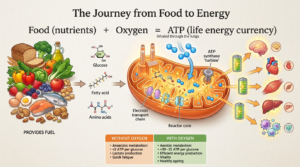
Oxygen: The Spark That Turns Food into Energy
Every one of the body’s estimated 30–40 trillion cells depends on adenosine triphosphate (ATP), often called the body’s energy currency.
Think of ATP as rechargeable batteries powering every biological process.
Where does ATP come from?
From the food we eat, but only with oxygen.
Imagine building a campfire.
- Food is the wood.
- Oxygen is the air feeding the flames.
- ATP is the heat produced.
Without enough oxygen, the fire smoulders rather than burns brightly.
Our cells behave similarly.
When oxygen is plentiful, one molecule of glucose produces approximately 30–32 molecules of ATP through aerobic metabolism inside mitochondria, the tiny “power stations” within our cells.
Without adequate oxygen, cells switch to anaerobic metabolism, producing only 2 ATP molecules from the same glucose molecule, together with lactate.
That’s about 15 times less energy from the same amount of food.
No wonder oxygen is so fundamental to vitality.
Your Body Is an Extraordinary Oxygen Delivery System
Every breath begins an extraordinary relay race.
Oxygen enters the lungs.
It diffuses into the bloodstream.
Haemoglobin in red blood cells carries it through arteries.
The heart pumps it to every organ.
Tiny capillaries deliver it to individual cells.
Finally, mitochondria use oxygen to manufacture ATP.
This seamless delivery system operates around the clock without us giving it a second thought.
Yet like every sophisticated system, it works best when maintained.
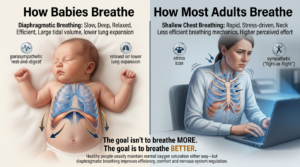
Why Babies May Be Nature’s Best Breathing Teachers
Watch a sleeping baby.
The abdomen gently rises and falls.
Breathing is slow, effortless, relaxed.
The diaphragm, the body’s primary breathing muscle, does almost all the work.
Now compare that with many adults.
Shoulders rise.
Chest expands only slightly.
Breaths become rapid and shallow.
Stress dominates.
We breathe as though we’re permanently rushing to catch a train.
Although healthy adults generally maintain excellent blood oxygen levels at rest, shallow breathing can make breathing less efficient and reinforce stress-related patterns. Deep diaphragmatic breathing recruits the lower lungs more effectively and stimulates the vagus nerve, encouraging the parasympathetic (“rest-and-digest”) nervous system.
Think of the lungs as a balloon.
Babies inflate the balloon from the bottom.
Many adults repeatedly puff only into the top.
Returning to slower, diaphragmatic breathing isn’t about dramatically increasing blood oxygen in healthy people; it is about improving breathing efficiency, reducing unnecessary effort and helping the nervous system regain balance.

Exercise: The Best Oxygen Booster Money Can’t Buy
Many people believe exercise simply strengthens muscles.
Aerobic exercise upgrades the entire oxygen delivery network.
Imagine transforming a country road into a modern motorway.
Regular aerobic exercise:
- Strengthens the heart, allowing it to pump more blood with each beat.
- Expands networks of tiny capillaries that deliver oxygen to muscles.
- Increases the number and efficiency of mitochondria.
- Improves muscles’ ability to extract oxygen from the blood.
- Enhances endurance while reducing fatigue.
This explains why people who exercise regularly often feel more energetic, not because they possess more oxygen, but because they use it far more efficiently.
Ironically, spending energy through exercise allows the body to make energy more efficiently.
VO₂ Max: Your Body’s Horsepower
If there were one number capable of predicting future vitality better than almost any other measure, it might be VO₂ max.
VO₂ max represents the maximum amount of oxygen your body can take in, transport and utilise during intense exercise.
Think of two mobile phones.
One has a tiny battery.
The other has a powerful battery that lasts all day.
Which one copes better under pressure?
Your VO₂ max is your biological battery capacity.
Research consistently shows that higher cardiorespiratory fitness is associated with lower risks of cardiovascular disease, diabetes, disability and premature death. It also provides greater “physiological reserve,” helping people better withstand illness and ageing.
The encouraging news?
VO₂ max can improve at almost any age through regular aerobic training.
Walking briskly, Cycling, Swimming, Rowing, Dancing.
Even short bouts of interval training.
It is never too late to upgrade your body’s engine.
Ancient Wisdom Meets Modern Science
Thousands of years before lung physiology was understood, Indian yogis developed Pranayama, structured breathing practices designed to calm the body and sharpen the mind.
Modern techniques include:
- Box breathing
- Coherent breathing
- Resonance breathing
- Slow nasal breathing
- Diaphragmatic breathing
Interestingly, modern research supports many of their benefits.
These practices may:
- Reduce stress hormones
- Improve heart-rate variability
- Enhance vagal tone
- Lower blood pressure in some individuals
- Improve breathing efficiency
- Promote better sleep and emotional resilience
The magic is not that they flood the body with extra oxygen. Most healthy people already have arterial oxygen saturations between 95% and 100%.
Rather, they help us breathe better, not simply more.
Sometimes less breathing done well is more effective.
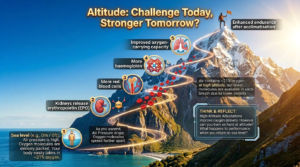
Why Do Kenyan and Ethiopian Runners Dominate Distance Running?
One fascinating clue lies thousands of metres above sea level.
Many elite East African runners grow up at moderate to high altitudes, where oxygen levels are lower.
Initially, altitude makes exercise much harder.
Breathing becomes difficult.
Performance falls.
Fatigue arrives earlier.
But with time, remarkable adaptations occur.
The kidneys release erythropoietin (EPO), stimulating the bone marrow to produce more red blood cells. More haemoglobin means a greater capacity to transport oxygen.
This happens while air contains about 21% oxygen whether you are at sea level or at high altitude, but the air pressure drops as you go higher and becomes less dense, and oxygen molecules spread apart, so you take in fewer of them with each breath.
Many elite athletes therefore “live high and train low”, sleeping at altitude while performing high-intensity workouts at lower elevations where oxygen availability is greater.
Hyperbaric Oxygen Therapy: Miracle or Measured Promise?
Hyperbaric oxygen therapy (HBOT) involves breathing nearly pure oxygen inside a pressurised chamber.
Under these conditions, substantially more oxygen dissolves into the blood and reaches tissues.
HBOT has well-established roles in treating:
- Decompression sickness
- Carbon monoxide poisoning
- Radiation tissue injury
- Selected chronic wounds
- Certain severe infections
Researchers are also investigating its potential in neurological disorders, diabetic complications, tissue repair and aspects of biological ageing.
Some early studies have generated excitement by suggesting improvements in markers related to ageing and cellular repair.
However, for healthy people seeking greater vitality or longevity, the evidence remains insufficient to recommend routine HBOT outside carefully selected clinical settings or research trials. It is expensive, time-consuming and not without risks, including ear barotrauma and, rarely, oxygen toxicity.
The simplest prescription remains remarkably old-fashioned:
Move your body.
Sleep well.
Eat wisely.
Manage stress.
Breathe efficiently.
These interventions have far stronger evidence than any oxygen chamber.
Simple Ways to Improve Your Oxygen Economy
You do not need expensive equipment.
Your body already possesses everything it needs.
Support it by:
- Walking most days briskly.
- Including aerobic exercise every week.
- Performing strength training to support muscle health.
- Practising diaphragmatic breathing for five to ten minutes daily.
- Maintaining good posture.
- Sleeping well.
- Avoiding smoking and vaping.
- Treating conditions such as asthma or sleep apnoea.
- Spending time outdoors.
- Tracking your fitness, not just your weight.
Remember, oxygen delivery is only half the story.
The real goal is helping your cells use oxygen efficiently.
The Real Secret to Energy
Many people chase more energy through coffee, supplements or expensive wellness products.
Yet perhaps the answer has been with us since birth.
Every breath represents an opportunity.
Not merely to survive.
But to thrive.
Food fills the fuel tank.
Exercise strengthens the engine.
The heart delivers the fuel.
The lungs supply the oxygen.
The mitochondria convert it into life itself.
Health is not simply about eating better.
It is about becoming better at turning food into energy.
And that journey begins with the very next breath.
Perhaps oxygen has been the forgotten fuel all along.
If you found this discussion useful, you may be interested in my recently published book, “Your Metabolic Shift”, which explores these concepts in greater depth.
Frequently Asked Questions
- Can breathing exercises increase blood oxygen levels?
In healthy individuals, blood oxygen saturation is already close to maximum. Breathing exercises mainly improve breathing efficiency, relaxation, stress control and respiratory mechanics rather than substantially increasing oxygen saturation.
- Why do babies breathe with their bellies?
Babies naturally use the diaphragm, the main breathing muscle, resulting in slow, efficient breathing. Adults often develop shallow chest breathing because of stress, prolonged sitting and poor posture.
- Is shallow breathing harmful?
Persistent shallow breathing may contribute to stress, anxiety and reduced breathing efficiency, although it does not usually cause low blood oxygen levels in healthy people.
- What is VO₂ max?
VO₂ max measures your body’s maximum ability to take in, transport and use oxygen during exercise. It is one of the best indicators of cardiorespiratory fitness.
- Can VO₂ max improve after age 50 or 60?
Yes. Regular aerobic exercise and appropriately supervised interval training can improve VO₂ max even in older adults.
- Is more oxygen always better?
No. Oxygen is essential, but excessive oxygen can be harmful in certain situations. Healthy people generally do not benefit from breathing high concentrations of oxygen without a medical indication.
- Does hyperbaric oxygen therapy slow ageing?
Research is promising but preliminary. HBOT has proven medical uses, but there is currently insufficient evidence to recommend it as a routine longevity treatment for healthy individuals.
- Why do elite runners train at altitude?
Altitude stimulates adaptations that improve oxygen transport, but success also depends on genetics, training, nutrition, recovery and coaching.
- Should I measure my oxygen level at home?
For healthy people, routine pulse oximetry offers little additional information. Improving fitness and monitoring exercise capacity are generally more informative than repeatedly checking oxygen saturation.
- What is the single best way to improve my body’s use of oxygen?
Regular aerobic exercise remains the most effective, affordable and scientifically supported strategy.
This article is intended for educational purposes only and should not replace personalised medical advice. Readers with existing medical conditions should consult their healthcare professional before making significant dietary or lifestyle changes.
References
- Hall JE. Guyton and Hall Textbook of Medical Physiology. 15th ed. Elsevier; 2024.
- Brooks GA, Fahey TD, Baldwin KM. Exercise Physiology: Human Bioenergetics and Its Applications. McGraw-Hill.
- American College of Sports Medicine. ACSM’s Guidelines for Exercise Testing and Prescription. 12th ed. Wolters Kluwer; 2025.
- Poole DC, Jones AM. Measurement of the maximum oxygen uptake (VO₂max): VO₂peak is no longer acceptable. J Appl Physiol. 2017;122:997–1002.
- Ross R, Blair SN, Arena R, et al. Importance of assessing cardiorespiratory fitness in clinical practice. Circulation. 2016;134:e653–e699.
- Myers J, Kokkinos P, Nyelin E. Cardiorespiratory fitness and all-cause mortality: A review of the evidence. Prog Cardiovasc Dis. 2019;62:136–143.
- World Health Organization. Guidelines on Physical Activity and Sedentary Behaviour. Geneva: WHO; 2020.
- Lehrer PM, Gevirtz R. Heart rate variability biofeedback: Mechanisms and clinical applications. Front Psychol. 2014;5:756.
- Jayaraman R, et al. Hyperbaric oxygen therapy: Current evidence and future directions. Med Gas Res. 2022;12:170–180.
- Hadanny A, Efrati S. The hyperoxic-hypoxic paradox. Med Hypotheses. 2020;141:109798.
- Millet GP, Debevec T, Brocherie F, et al. Therapeutic use of exercising in hypoxia: Promises and limitations. Front Physiol. 2016;7:224.
- Harvard Health Publishing. VO₂ max: What it is and how you can improve it. Harvard Medical School. Updated 2026.