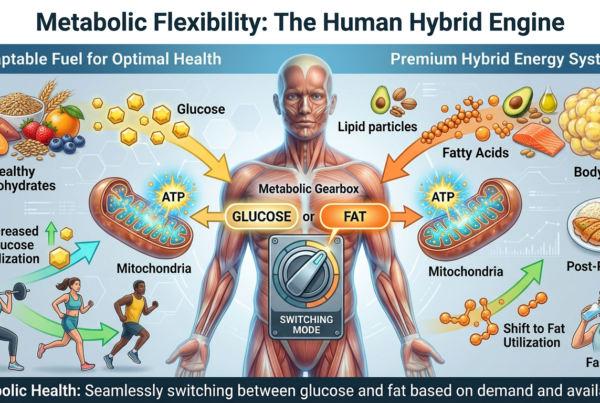
Why insulin resistance is far more than high blood sugar and why even a lean, highly trained athlete can sometimes receive an unexpected prediabetes result.
Imagine someone who trains five days a week.
They are lean. Their waist circumference is excellent. Their resting heart rate would make many people envious. They run, cycle or lift weights, avoid obvious junk food and have spent years doing almost everything we associate with metabolic health.
Then the blood test arrives.
HbA1c: prediabetes range.
The reaction is understandable:
How can I possibly be prediabetic?
This is where our usual picture of insulin resistance begins to fail us.
Insulin resistance is often portrayed as the consequence of obesity, inactivity and excessive sugar consumption. These are certainly major drivers, but the biology is considerably more sophisticated.
Insulin resistance is not one switch that suddenly turns off.
It is a quiet metabolic shift: different tissues gradually or sometimes temporarily stop interpreting insulin’s message in the same way.
And occasionally, what looks like insulin resistance on one test may represent something quite different.
Beyond the Lock and Key
Previously, we used a simple mental picture.
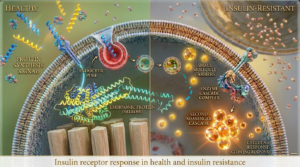
Insulin knocks on the cell’s door. GLUT4, the glucose transporter, helps open the entrance so glucose can move from the bloodstream into skeletal muscle and adipose cells.
That remains useful.
But now we need to look behind the door.
When insulin binds to its receptor, it activates an extraordinarily sophisticated intracellular communication network. Think of it less like turning a key and more like triggering a corporate chain of command.
Insulin receptor → IRS proteins → PI3K → Akt → multiple metabolic instructions.
Among those instructions is the movement of GLUT4-containing vesicles toward the cell membrane in skeletal muscle and adipose tissue.
But insulin does much more.
It tells the liver to reduce glucose production. It encourages muscle to store glucose as glycogen. It tells adipose tissue to suppress the release of fatty acids. It influences protein synthesis, lipid metabolism, blood-vessel function and even signalling within the brain.
Insulin resistance therefore does not necessarily mean that every insulin pathway fails simultaneously.
Some messages become muffled while others remain surprisingly loud.
This phenomenon, selective insulin resistance, is one of the most important concepts in modern metabolic medicine.[1,2]
When the Signal Becomes Distorted
Imagine an office where management keeps sending instructions, but the internal communication system is failing.
The obvious response is to send more emails.
That is essentially what the pancreas initially does.
As tissues become less responsive to insulin, pancreatic beta cells compensate by producing more insulin.
Blood glucose may therefore remain perfectly normal for years.
The laboratory report says everything is fine.
But behind that reassuring glucose result, insulin may be working overtime.
This is compensatory hyperinsulinaemia.
Eventually, if beta cells can no longer compensate sufficiently, glucose begins to rise. Prediabetes and, in susceptible people, type 2 diabetes can follow.
The important point is that elevated glucose may be relatively late in the story.
The metabolic disturbance may have begun much earlier.
Lipotoxicity: When Fat Arrives in the Wrong Place
Body fat itself is not the enemy.
Healthy adipose tissue is an extraordinarily useful metabolic storage organ.
The problem begins when the body’s safe storage capacity is exceeded, or adipose tissue becomes dysfunctional.
Fatty acids then begin accumulating where they are not supposed to accumulate, particularly in the liver and skeletal muscle.
Think of adipose tissue as the body’s warehouse.
When the warehouse works properly, it packages and stores incoming energy safely.
But when storage becomes dysfunctional, boxes begin appearing in the corridors, offices and machinery rooms.
Inside cells, lipid intermediates such as diacylglycerols and ceramides can interfere with insulin signalling. Protein kinases are activated, inhibitory phosphorylation of insulin-receptor signalling proteins increases, and the message travelling from the insulin receptor towards Akt and GLUT4 becomes weaker.[3]
This is lipotoxicity.
Importantly, it is not simply how much fat exists in the body that matters.
Where fat is stored and how effectively adipose tissue can contain it matters enormously.
Inflammation: Metabolism’s Background Noise
As adipose tissue becomes stressed, its biology changes.
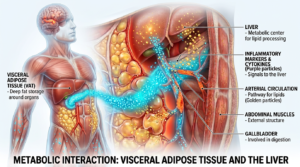
Enlarged and dysfunctional adipocytes release altered patterns of adipokines and inflammatory signals. Immune cells infiltrate the tissue. Cytokines including TNF-α and others can activate stress pathways such as JNK and IKKβ.
The result is low-grade chronic metabolic inflammation.
Imagine trying to conduct a telephone conversation in a room becoming progressively noisier.
Insulin is still speaking.
The receptor may still hear it.
But the intracellular message is increasingly distorted by metabolic noise.
Lipotoxicity, oxidative stress, mitochondrial stress and inflammation therefore reinforce one another, creating a biological environment in which insulin signalling becomes progressively less efficient.[3,4]
Insulin Resistance Is Different in Different Organs
This is where the subject becomes particularly interesting.
There isn’t really one insulin resistance.
Multiple tissue-specific insulin resistances occur simultaneously and interact with each other.
Skeletal muscle: the glucose reservoir
Skeletal muscle is one of the body’s major destinations for glucose after a meal.
When muscle becomes insulin resistant, Akt signalling and GLUT4 trafficking can become impaired. Less glucose enters muscle efficiently and less is directed towards glycogen storage.
The pancreas compensates by producing more insulin.
Exercise is extraordinarily powerful here because muscle contraction can stimulate GLUT4 translocation through pathways that are partly independent of insulin.
In other words, exercise has another way of opening the door.
Liver: the factory that refuses to shut down
The liver presents a different problem.
One of insulin’s normal jobs is to tell the liver:
We have enough glucose. Stop making more.
With hepatic insulin resistance, that instruction becomes less effective and hepatic glucose production remains inappropriately high.
Yet another insulin-driven pathway, lipogenesis, may remain relatively active.
The result is a remarkable metabolic contradiction:
the liver can resist insulin’s instruction to stop producing glucose while continuing to respond to signals promoting fat production.
This selective resistance helps explain why insulin resistance can coexist with fatty liver, raised triglycerides and increased VLDL production.[1]
Adipose tissue: the leaking warehouse
Insulin normally suppresses lipolysis, the release of stored fatty acids.
When adipose tissue becomes insulin resistant, that restraint weakens.
More free fatty acids enter the circulation.
They reach the liver.
They reach skeletal muscle.
They generate lipid intermediates.
And those tissues can become still more insulin resistant.
The warehouse has begun leaking into the rest of the metabolic city.
Brain: insulin is signalling here too
Insulin also acts in the central nervous system and participates in networks involved in appetite, energy balance and cognition.
Brain insulin resistance is an important area of research, particularly in neurodegenerative disease.
You may have heard Alzheimer’s disease described as “type 3 diabetes.”
It is an intriguing phrase, but it should not be presented as an established medical diagnosis.
There are meaningful associations between impaired cerebral insulin signalling, metabolic dysfunction and Alzheimer’s disease, but Alzheimer’s is multifactorial and “type 3 diabetes” remains a research concept rather than a recognised diagnostic category.
That distinction matters.
The Athlete Who Is Told They Have Prediabetes
Now return to our athlete staring at that laboratory report.
An HbA1c between 5.7% and 6.4% is classified by the American Diabetes Association as being within the prediabetes range.[5]
But a threshold is not the same thing as a complete metabolic diagnosis.
Athletes provide a fascinating example.
Regular exercise generally improves insulin sensitivity dramatically. Trained muscle typically contains more GLUT4 and has an enhanced capacity for glucose disposal.
Yet glucose physiology around intensive training can sometimes produce apparently contradictory results.
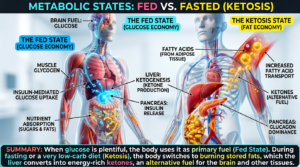
After prolonged endurance exercise, the body may deliberately shift towards increased fatty-acid oxidation. Research in endurance-trained athletes has demonstrated increased circulating free fatty acids and ketones and temporarily reduced glucose tolerance the following day.[6]
Why would the body do that?
Imagine glucose as premium emergency fuel.
After hours of endurance exercise, the body may temporarily favour fat as a fuel and conserve glucose for tissues with a greater requirement for it.
This has been described as a form of physiological insulin resistance or glucose sparing, a context-dependent metabolic adaptation rather than necessarily the same process seen in metabolic syndrome.
Training load, recovery, carbohydrate availability, sleep, stress hormones and the timing of testing can all influence the picture.
CGM adds another complication. Studies of athletes without diabetes show that substantial glucose excursions can occur during extreme exercise, and there is currently no universally accepted framework for interpreting CGM data in healthy athletes.[7,8]
So when a metabolically healthy-looking athlete receives a prediabetes-range result, the answer should not be:
“Ignore it—you exercise.”
Nor should it automatically be:
“You have metabolic disease.”
The better response is:
Let’s understand the physiology behind the number.
Repeated fasting glucose, HbA1c, an oral glucose-tolerance test where appropriate, fasting insulin or other markers in selected circumstances, lipid profile, blood pressure, family history, training load, diet and overall clinical context can tell a much richer story than one isolated measurement.
Fitness is enormously protective.
But fitness does not make anyone metabolically invincible.
When Carbohydrate and Fat Arrive Together
We have previously discussed meals that combine large quantities of refined carbohydrate and fat—the classic modern combination of pizza, pastries, chips, burgers, desserts, and many ultra-processed foods.
One important refinement is needed.
Fat does not necessarily make the early glucose spike higher. In fact, because fat slows gastric emptying, adding fat to carbohydrate can sometimes reduce or delay the initial glucose peak.[9]
The problem can appear later.
A large energy-dense meal containing substantial carbohydrate and fat can create a prolonged metabolic workload involving glucose, insulin, triglycerides and circulating fatty acids.
Instead of thinking only about the height of the glucose mountain, think about the total time spent travelling across the mountain range.
A lower early peak does not automatically mean a metabolically benign meal.
This is why looking at glucose alone can sometimes obscure the larger metabolic picture.
Hyperinsulinaemia: The Compensation Has Consequences
For years, rising insulin can successfully maintain normal glucose.
But chronically elevated insulin is not metabolically neutral.
One particularly fascinating example occurs in blood vessels.
Healthy insulin signalling through the PI3K–Akt–eNOS pathway promotes nitric oxide production, helping blood vessels relax and increasing blood flow to metabolically active tissues.
In insulin-resistant states, this pathway can become impaired.
Meanwhile, other signalling pathways—including MAPK-related pathways may remain relatively responsive.
Now combine selective resistance with high circulating insulin.
The beneficial vasodilatory signal becomes weaker while some growth-promoting and vasoconstrictive signalling remains active.
The balance shifts.
This contributes to endothelial dysfunction, impaired nitric-oxide biology, vascular inflammation and eventually increased cardiovascular risk.[10]
At the same time, hepatic insulin resistance and persistent insulin signalling can promote triglyceride synthesis and VLDL secretion.
The familiar lipid pattern begins to emerge:
higher triglycerides, lower HDL cholesterol and an increased burden of atherogenic remnant and apoB-containing particles.
What began as a problem of insulin signalling has become a whole-body cardiovascular problem.
The Quiet Shift Becomes a Systemic Disease
This is why insulin resistance deserves attention long before diabetes appears.
It can connect:
muscle glucose resistance → compensatory insulin → adipose dysfunction → increased fatty-acid flux → hepatic fat accumulation → dyslipidaemia → endothelial dysfunction → beta-cell stress.
These are not separate diseases accidentally occurring in the same person.
They are interconnected chapters of the same metabolic story.
And the story is not inevitable.
Muscle contraction improves glucose disposal. Losing excess visceral fat where present reduces fatty-acid flux. Resistance and aerobic exercise improve metabolic flexibility. Sleep, energy balance, dietary quality and meal composition matter.
Most importantly, insulin resistance exists on a continuum.
There is no midnight moment when someone suddenly changes from “insulin sensitive” to “insulin resistant.”
The shift may be quiet.
But quiet does not mean harmless.

The Take-Home Message
Insulin resistance is much more sophisticated than “too much sugar in the blood.”
It is a disturbance in the body’s metabolic communication network.
The insulin receptor may receive the message, but downstream signalling becomes altered. Lipid intermediates interfere with the circuitry. Inflammation adds noise. Different organs respond differently. The pancreas compensates with more insulin. Blood glucose may remain normal until compensation eventually becomes insufficient.
And occasionally, particularly in highly trained athletes, an apparently abnormal glucose measurement may reflect physiology that requires interpretation rather than an immediate label.
The number matters. But the biology behind the number matters more.
That may be the most important evolution in how we think about metabolic health.
Do not wait only for glucose to rise.
Understand what insulin has been trying to tell us long before it does.
If you found this discussion useful, you may be interested in my recently published book, “Your Metabolic Shift”, which explores these concepts in greater depth.
Frequently Asked Questions
Can a thin or athletic person become insulin resistant?
Yes. Low body fat and high fitness substantially reduce risk, but they do not eliminate genetic susceptibility, ectopic fat, sleep disturbance, medication effects, ageing or other contributors. In athletes, temporary changes in glucose tolerance can also occur around prolonged exercise, so abnormal results require appropriate clinical interpretation.
Does a prediabetes-range HbA1c automatically mean I have insulin resistance?
No. HbA1c estimates average glycaemic exposure and does not directly measure insulin sensitivity. Interpret results alongside glucose measurements and the clinical picture, particularly when they appear inconsistent.
Is fasting insulin useful?
It can provide additional metabolic information, particularly alongside fasting glucose, but no universally standardised fasting-insulin threshold independently diagnoses insulin resistance. Techniques such as the hyperinsulinaemic-euglycaemic clamp remain research gold standards but are impractical for routine care.
Does insulin resistance always cause high blood glucose?
No. Early insulin resistance may be accompanied by normal glucose because pancreatic beta cells compensate by secreting more insulin. Hyperglycaemia develops when compensation becomes inadequate relative to insulin resistance.
Is fatty liver connected to insulin resistance?
Very closely. Hepatic insulin resistance, increased fatty-acid delivery, de novo lipogenesis, and excess liver fat can reinforce one another, although the relationships are complex and bidirectional.
Is Alzheimer’s disease really “type 3 diabetes”?
No, not as an accepted clinical diagnosis. Brain insulin resistance is an active and important field of Alzheimer’s research, but calling Alzheimer’s “type 3 diabetes” oversimplifies a complex neurodegenerative disease.
Can exercise reverse insulin resistance?
Exercise is one of the most powerful interventions for improving insulin sensitivity. Both aerobic and resistance exercise can improve glucose disposal and metabolic health, sometimes even before major weight loss occurs. But exercise does not eliminate every cause of dysglycaemia, so unexpectedly abnormal results in very active people should still be investigated rather than dismissed.
This article is intended for general education and does not replace individual medical assessment. Unexpected HbA1c, fasting glucose or glucose-tolerance results, whether in athletes or non-athletes, should be interpreted in their full clinical context.
References
- Accili D, Deng Z, Liu Q. Insulin resistance in type 2 diabetes mellitus. Nature Reviews Endocrinology. 2025;21:413–426. doi:10.1038/s41574-025-01114-y.
- Burchfield JG, Diaz-Vegas A, James DE. The insulin signalling network. Nature Metabolism. 2025;7:1745–1764. doi:10.1038/s42255-025-01349-z.
- Levate G, Stimson RH. Molecular signatures of skeletal muscle insulin resistance: bringing personalised diabetes treatment a step closer. Signal Transduction and Targeted Therapy. 2025;10:320. doi:10.1038/s41392-025-02412-7.
- Dutta S. JNK at the helm: decoding obesity-driven insulin resistance. Nature Reviews Endocrinology. 2025;21:459. doi:10.1038/s41574-025-01117-9.
- American Diabetes Association Professional Practice Committee. Diagnosis and Classification of Diabetes: Standards of Care in Diabetes. Diabetes Care. 2024;47(Suppl 1):S20–S42.
- Flockhart M, Tischer D, Nilsson LC, Blackwood SJ, Ekblom B, Katz A, Apró W, Larsen FJ. Reduced glucose tolerance and insulin sensitivity after prolonged exercise in endurance athletes. Acta Physiologica. 2023;238(4):e13972. doi:10.1111/apha.13972.
- Flockhart M, Larsen FJ. Continuous glucose monitoring in endurance athletes: interpretation and relevance of measurements for improving performance and health. Sports Medicine. 2024;54(2):247–255. doi:10.1007/s40279-023-01910-4.
- Beyond Euglycemia: Case Studies Using Continuous Glucose Monitoring in Elite Athletes Without Diabetes During Record Athletic Events. PubMed-indexed case series, 2026. PMID: 41829603.
- Kdekian A, Alssema M, Van Der Beek EM, Greyling A, Vermeer MA, Mela DJ, Trautwein EA. Impact of isocaloric exchanges of carbohydrate for fat on postprandial glucose, insulin, triglycerides, and free fatty acid responses: a systematic review and meta-analysis. European Journal of Clinical Nutrition. 2020;74(1):1–8. doi:10.1038/s41430-019-0534-6.
- King GL, Park K, Li Q. Selective insulin resistance and the development of cardiovascular diseases in diabetes: the 2015 Edwin Bierman Award Lecture. Diabetes. 2016;65:1462–1471. See also contemporary reviews of insulin signalling and endothelial dysfunction.