
Discover how your body switches between burning glucose and fat and how exercise, insulin, mitochondria, nutrition and ageing determine how well your metabolic engine performs.
We were designed to survive winter. We now live in permanent summer.
For most of human history, food availability fluctuated. There were periods of abundance and periods of scarcity. Fruit ripened seasonally. Successful hunting produced a temporary feast. Winter could mean weeks when energy was much harder to find.
The human body therefore evolved something extraordinarily useful: the ability to store energy when it was abundant and retrieve it when it wasn’t.
Think of our ancestors at the end of summer. Storing some excess energy as body fat was not a metabolic failure. It was life insurance.
The problem is that winter rarely comes anymore.
Our supermarkets are permanently stocked. Food is available from morning until midnight. We can consume refined carbohydrates repeatedly throughout the day. Meanwhile, many of us spend most of that day sitting down.
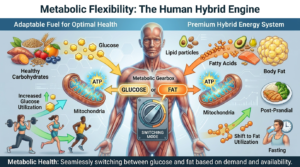
The ancient metabolic machine is still doing exactly what it was designed to do: it stores energy.
But increasingly, it gets fewer opportunities to practise the other half of the equation: switching from storage to utilisation.
That ability is called metabolic flexibility: the capacity to alter fuel use according to what is available and what the body is being asked to do. At its simplest, a metabolically flexible person can move efficiently between glucose and fat oxidation. Researchers increasingly view impaired flexibility as part of the metabolic disturbance associated with obesity and insulin resistance.
Perhaps the best mental picture is not a petrol engine.
It is a hybrid.
A good hybrid does not insist on using one fuel all the time. It selects the appropriate energy source for the circumstances.
Your metabolism should do something similar.
Two fuels, different jobs
After a carbohydrate-containing meal, glucose rises in the circulation, and the pancreas releases insulin.
Insulin tells tissues, in effect:
“Fuel has arrived.”
It promotes glucose uptake and storage, stimulates glycogen formation and supports anabolic processes. At the same time, insulin suppresses the release of fatty acids from adipose tissue.
This is an important distinction. Insulin does not literally make fat burning impossible. Human physiology is rarely an on/off switch. But higher insulin generally shifts metabolism towards storage and carbohydrate utilisation while suppressing lipolysis.
Hours later, as insulin falls, stored energy becomes increasingly accessible. Fatty acids can leave adipose tissue and travel to tissues where mitochondria can oxidise them.
The flexible metabolism therefore moves continually between states:
Fed → store and use incoming energy.
Fasted → increasingly mobilise stored energy.
Neither state is unhealthy.
The ability to move appropriately between them is the point.
Then you start exercising, and the gearbox changes again
Fuel selection is not determined only by what you ate.
It also depends enormously on how hard you are asking your body to work.
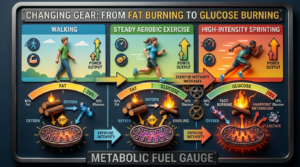
Imagine walking briskly.
Energy demand is relatively modest, and oxygen is readily available. Your muscles can obtain a substantial proportion of their energy through fat oxidation.
Increase the pace into a steady run and carbohydrate contributes progressively more.
Now sprint uphill for 30 seconds.
The metabolic requirement has changed completely. ATP must be produced extraordinarily quickly. Carbohydrate, particularly muscle glycogen, becomes extremely valuable.
This relationship is described by the crossover concept: as exercise intensity rises, reliance generally shifts from fat towards carbohydrate.
That helps explain the often misunderstood “fat-burning zone.”
Fat oxidation commonly reaches its highest rate during low-to-moderate exercise rather than during very intense exercise. The precise intensity varies considerably between people and is influenced by fitness, diet, sex and training status.
But this does not mean that exercising harder stops being useful for fat loss.
It simply means the engine changes fuel.
During HIIT, carbohydrate contribution rises dramatically because glucose and glycogen can supply energy at the rate demanded by contracting muscle. After exercise, metabolism changes again.
So rather than asking:
“Which exercise burns the more fat?”
a better question is:
“Can my metabolism efficiently use the right fuel for the job?”
That is metabolic flexibility.
Oxygen changes the economics
Another fascinating part of this story is oxygen.
Both carbohydrate and fat can ultimately be oxidised inside mitochondria to generate ATP, but their economics are different.
Fat contains enormous amounts of stored energy. Even a lean person carries many thousands of kilocalories in adipose tissue.
But accessing that energy is comparatively slower and more oxygen-demanding.
Carbohydrate can provide ATP rapidly and produces more usable energy per litre of oxygen consumed than fat. This becomes particularly important as exercise intensity rises.
Imagine two fires.
Fat is like a huge pile of slow-burning logs. Enormous energy is available, but extracting it efficiently requires oxygen and time.
Carbohydrate is more like dry kindling.
When energy demand suddenly explodes sprinting, climbing stairs rapidly, lifting heavily – the body reaches for the fuel capable of responding quickly.
This is why being an excellent fat burner does not mean carbohydrate has become metabolically unnecessary.
A healthy metabolism should be able to burn both.
The low-carbohydrate paradox
This brings us to something I increasingly notice among apparently very health-conscious people.
They exercise. They avoid processed foods. They maintain a healthy weight. They may fast regularly.
And yet some consume extremely little carbohydrate because they believe remaining in a fat-burning state automatically represents superior metabolic health.
That assumption deserves scrutiny.
A ketogenic or very-low-carbohydrate diet can dramatically increase fat oxidation. But increased fat burning is not the same as metabolic flexibility.
If you remove most carbohydrate from the diet, the body naturally becomes extremely good at using fat because that is the fuel predominantly available.
The more interesting test of flexibility is what happens when carbohydrate becomes available again.
Can the system change gear?
Recent systematic reviews in athletes show that low-carbohydrate and ketogenic diets consistently increase fat oxidation, while performance effects vary. High-intensity and repeated-sprint activities depend heavily on glycolytic energy and glycogen availability, and carbohydrate restriction can impair some of these demands.
The latest debate in endurance nutrition reaches a nuanced conclusion: fat adaptation can be substantial, but carbohydrate availability remains particularly valuable when exercise intensity demands rapid ATP production.
This does not make low-carbohydrate diets inherently unhealthy.
It means we should distinguish metabolic adaptation from metabolic flexibility.
Owning an excellent diesel engine is impressive.
But a hybrid should still be able to use its other motor.
Insulin is not the villain
Modern metabolic conversations often portray insulin as something we should keep permanently low.
That oversimplifies its biology.
Insulin is an essential anabolic hormone. Without it, normal glucose regulation and nutrient storage become impossible.
The issue is not that insulin rises after eating.
It is supposed to.
The more important question is whether insulin can rise when required, perform its job efficiently, and then fall again.
In insulin resistance, tissues respond less effectively to insulin. The pancreas may compensate by producing more. Over time, metabolic regulation becomes increasingly strained.
Muscle matters enormously here.
Skeletal muscle represents a major destination for glucose disposal, particularly following meals and exercise. Maintaining and exercising muscle therefore provides something rather like expanding the body’s metabolic storage warehouse.
This is another reason Muscle Wealth and Metabolic Wealth are inseparable.
Why does changing gear become harder with age?
People sometimes describe 40 as though the body suddenly receives a metabolic software downgrade.
It doesn’t.
There is no universal metabolic cliff on your 40th birthday.
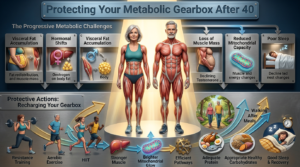
Instead, physiological reserve gradually erodes, which can become increasingly noticeable through midlife.
Without intervention, muscle mass and function tend to decline. Mitochondrial function can deteriorate. Visceral fat may increase. Physical activity often falls. Chronic inflammation becomes more common. Sleep may deteriorate.
Together, these changes can impair insulin sensitivity and tissues’ ability to respond dynamically to changing energy demands. Contemporary research increasingly describes age-related insulin resistance as the consequence of declining reserve across several interconnected systems rather than a single defective pathway.
The encouraging part is that chronological ageing and metabolic ageing are not identical.
Exercise helps preserve mitochondrial respiration, muscle and insulin sensitivity, opposing many aspects of secondary metabolic ageing.
You cannot stop the clock.
But you can influence how much metabolic machinery you retain.
Menopause: when the metabolic landscape changes
For women, midlife brings another powerful variable.
Oestrogen does far more than regulate reproduction. It interacts with skeletal muscle, adipose tissue, glucose metabolism and insulin signalling.
During the menopausal transition, declining and fluctuating oestrogen is associated with changes in body composition, including a tendency towards increased visceral adiposity and deterioration in aspects of cardiometabolic health.
Women generally have an insulin-sensitivity advantage over men earlier in adulthood, but that advantage diminishes after menopause.
Importantly, this does not mean metabolic decline is inevitable.
Exercise remains remarkably powerful. Research in postmenopausal women demonstrates that high-intensity training can improve muscle glucose uptake, muscle mass and peripheral insulin sensitivity.
Hormone therapy may also affect insulin resistance in appropriate women, but menopausal hormone therapy is a clinical decision requiring individual assessment of symptoms, risks, benefits and contraindications, not a metabolic supplement to prescribe universally.
And what about the male “andropause”?
Men experience a different hormonal trajectory.
Unlike menopause, there is usually no abrupt universal shutdown of testosterone production at a particular age. Testosterone may decline gradually, and obesity, illness, sleep disturbance and metabolic dysfunction can contribute.
The relationship is also bidirectional.
Low testosterone is associated with poorer metabolic health and insulin resistance, while obesity and insulin resistance can themselves suppress the hypothalamic-pituitary-gonadal axis.
So low testosterone should not automatically be interpreted as simply “getting older,” nor should testosterone replacement be regarded as a general anti-ageing treatment.
True hypogonadism requires appropriate clinical symptoms and biochemical investigation. Current expert reviews emphasise health optimisation as a central strategy, particularly where obesity or metabolic disease contributes to functional hypogonadism.
Again, muscle, body composition, hormones and metabolism are interconnected.

Final thoughts
Think of metabolism as a gearbox.
A gearbox remains useful because it regularly changes gears.
Modern life can keep us stuck in one.
The goal is not permanent ketosis, permanent fasting or permanently low insulin. Nor is it constant carbohydrate feeding.
The goal is appropriate metabolic movement.
Because the healthiest engine isn’t the one that burns fat all the time.
It is the one that can change gear when the road changes.
If you found this discussion useful, you may be interested in my recently published book, “Your Metabolic Shift”, which explores these concepts in greater depth.
Frequently Asked Questions
Does insulin completely stop fat burning?
No. Metabolism is not binary. Higher insulin suppresses lipolysis and generally shifts metabolism towards glucose use and energy storage, but fat oxidation does not simply fall to zero.
Is the “fat-burning zone” real?
Yes, physiologically—but it is frequently misinterpreted. Fat oxidation tends to peak at a moderate exercise intensity, with substantial individual variation. Above the crossover region, carbohydrate progressively becomes the dominant fuel.
Is HIIT bad for fat burning?
No. During high-intensity exercise, the body relies heavily on carbohydrate because rapid ATP production is required. HIIT can nevertheless improve fitness, insulin sensitivity and metabolic function. Fuel used during the exercise session should not be confused with the overall health effect of the exercise.
Does eating carbohydrate make you metabolically inflexible?
Not by itself. Healthy people should be able to handle carbohydrate appropriately. Persistent energy excess, inactivity, visceral adiposity, muscle loss, and insulin resistance are much more relevant to impaired metabolic health.
Can a ketogenic diet improve metabolic health?
For some people and some clinical situations, carbohydrate restriction can improve weight, glycaemic control and other metabolic markers. It also substantially increases fat oxidation. But being adapted to burning fat does not automatically demonstrate superior flexibility across every metabolic challenge.
Should healthy people deliberately eat carbohydrate?
Diet needs vary considerably. But carbohydrate is a legitimate physiological fuel, particularly for higher-intensity exercise. The useful distinction is between appropriate quantities of minimally processed carbohydrate matched to metabolic demand and chronically excessive intake of energy-dense refined foods.
Does metabolic flexibility decline after 40?
There is no precise age at which it suddenly declines. Ageing is associated with changes in muscle, mitochondria, adipose tissue, inflammation and hormones that can progressively impair insulin sensitivity and metabolic reserve. Physical activity and exercise can substantially counter these changes.
Can menopause affect metabolic flexibility?
Yes. The menopausal transition is associated with changes in oestrogen signalling, fat distribution, skeletal muscle and cardiometabolic risk. Increased visceral adiposity is particularly important. Exercise remains one of the strongest tools available for protecting metabolic health through this transition.
Is low testosterone simply part of ageing?
Not necessarily. Testosterone can decline with age, but obesity, metabolic disease and other health factors can also suppress testosterone. Persistent symptoms warrant proper clinical assessment rather than assuming “andropause” or self-treating with testosterone.
This article is intended for educational purposes only and should not replace personalised medical advice. Readers with existing medical conditions should consult their healthcare professional before making significant dietary or lifestyle changes.
References
- Brooks GA, Mercier J. Balance of carbohydrate and lipid utilisation during exercise: the “crossover” concept. Journal of Applied Physiology. 1994;76(6):2253–2261. doi:10.1152/jappl.1994.76.6.2253.
- Corpeleijn E, Saris WHM, Blaak EE. Metabolic flexibility in the development of insulin resistance and type 2 diabetes: effects of lifestyle. Obesity Reviews. 2009;10(2):178–193. doi:10.1111/j.1467-789X.2008.00544.x.
- Goodpaster BH, Sparks LM. Metabolic flexibility in health and disease. Cell Metabolism. 2017;25(5):1027–1036.
- Smith RL, Soeters MR, Wüst RCI, Houtkooper RH. Metabolic flexibility as an adaptation to energy resources and requirements in health and disease. Endocrine Reviews. 2018;39(4):489–517.
- Apostolopoulou M, Mastrototaro L, Hartwig S, et al. Metabolic responsiveness to training depends on insulin sensitivity and protein content of exosomes in insulin-resistant males. Science Advances. 2021.
- Tosti V, Bertozzi B, Fontana L. Health benefits of the Mediterranean diet: metabolic and molecular mechanisms. Journals of Gerontology Series A. 2018;73(3):318–326.
- Maunder E, Plews DJ, Kilding AE. Contextualising maximal fat oxidation during exercise: determinants and normative values. Frontiers in Physiology. 2018;9:599. See also contemporary reviews of factors affecting maximal fat oxidation.
- Brun JF, et al. Beyond the calorie paradigm: taking into account in practice the balance of fat and carbohydrate oxidation during exercise? Nutrients. 2022;14.
- Brooks GA, Mercier J. Mammalian fuel utilisation and the crossover model of exercise metabolism. Supporting physiological literature on carbohydrate dependence with increasing exercise intensity.
- Spriet LL. Metabolic regulation of fat use during exercise and in recovery. Nestlé Nutrition Institute Workshop Series. 2011/2012.
- Murphy NE, Carrigan CT, Margolis LM. High-fat ketogenic diets and physical performance: a systematic perspective. Recent systematic evidence concerning low-carbohydrate diets and athletic performance is summarised in current reviews.
- Burke LM, et al. Does a low-carbohydrate diet impede endurance sports performance? Debate consensus. American Journal of Clinical Nutrition. 2026. doi:10.1016/j.ajcnut.2026.101271.
- Zierath JR, Wallberg-Henriksson H. Exercise promotes healthy aging of skeletal muscle. Cell Metabolism. 2016;23(6):1034–1046.
- Juppi HK, Karppinen JE, Laakkonen EK. Menopause and body composition: a complex field. Seminars in Reproductive Medicine. 2025;43(2):85–105. doi:10.1055/s-0045-1809531.
- Marlatt KL, et al. Body composition and cardiometabolic health across the menopause transition. Obesity. 2022.
- Feng Y, Shi R. Estrogen in skeletal muscle: metabolism, mechanisms, and exercise-induced changes. Journal of Endocrinological Investigation. 2026;49(3):509–528. doi:10.1007/s40618-025-02726-x.
- Li T, Jiang NS, Kaskey J, Schnatz PF, Nudy M. Hormone therapy and insulin resistance in non-diabetic postmenopausal women: a systematic review and meta-analysis. Climacteric. 2025;28(6):673–681. doi:10.1080/13697137.2025.2509844.
- Jayasena CN, et al. Male hypogonadism: pathogenesis, diagnosis, and management. Lancet Diabetes & Endocrinology. 2024. doi:10.1016/S2213-8587(24)00199-2.
- Miller C, Madden-Doyle L, Jayasena C, et al. Mechanisms in endocrinology: hypogonadism and metabolic health in men—novel insights into pathophysiology. European Journal of Endocrinology. 2024;191(6)–R17. doi:10.1093/ejendo/lvae128.
- Hayes FJ. Testosterone and insulin resistance in men: evidence for a complex bi-directional relationship. Transactions of the American Clinical and Climatological Association. 2025;135:297–305.
- Sakaguchi M. Aging-induced dysfunction of adipose tissue and skeletal muscle and its link to insulin resistance. Journal of Biochemistry. 2026;179(4):221–230. doi:10.1093/jb/mvaf081.
- Boccardi V, et al. Rethinking insulin resistance in aging: a reserve-oriented clinical framework. Ageing Research Reviews. 2026. doi:10.1016/j.arr.2026.103180.
Tags
Metabolic Flexibility · Metabolic Health · Healthy Ageing · Insulin Resistance · Mitochondria · Exercise · Nutrition · Muscle Health · Menopause · Hormonal Health · Longevity


