
Imagine trying to fix a flooded house by mopping the floor… while the tap is still running.
That is how we often approach chronic metabolic disease.
We focus on blood sugar, cholesterol, and blood pressure, the visible puddles, while the underlying drivers quietly continue in the background. Then comes the question many patients (and doctors) ask:
“If I lose weight, will this all go away?”
It’s a powerful question.
And the answer is both encouraging and uncomfortable.

Weight loss: A powerful lever but not a magic wand
Weight loss is one of the most effective tools we have for improving metabolic health.
In conditions like type 2 diabetes, fatty liver disease, hypertension, and prediabetes, losing weight can:
- Improve insulin sensitivity
- Reduce liver fat
- Lower blood pressure
- Improve lipid profiles
- And in some cases, lead to remission of diabetes
Think of excess body fat, particularly visceral fat around organs, as a kind of metabolic “traffic jam.” Signals that regulate glucose, insulin, and inflammation get disrupted.
When weight is reduced, especially by losing this harmful fat, traffic starts to move again.
In some individuals, particularly early in the disease process, this can be dramatic. Blood sugars normalise. Medications are reduced or even stopped. The system appears to reset.
That’s the hopeful part.
But here’s the reality: Not everyone responds the same way
If weight loss were the whole answer, this would be simple.
It isn’t.
Two people can lose the same amount of weight and have completely different outcomes.
Why?
Because weight is not the disease, it is a marker of deeper processes.
Let’s use another image.
Imagine metabolic disease as a fire:
- Weight is the smoke
- Insulin resistance is the flame
- Lifestyle, environment, genetics, sleep, stress, these are the fuel sources
Removing smoke helps visibility.
But unless you deal with the fire itself, it will keep burning.
This is why some people with relatively modest weight loss see major improvements, while others struggle despite significant effort.
Remission vs cure: choosing our words carefully
In medicine, words matter.
We do not usually talk about “curing” metabolic disease. Instead, we talk about remission.
Remission means:
- Blood markers return to normal ranges
- Medications may no longer be needed
- But the underlying susceptibility remains
The system is stable but still sensitive.
Like a controlled fire that can reignite if conditions return.
This distinction is important because it shifts the goal from a short-term fix to long-term management and maintenance.
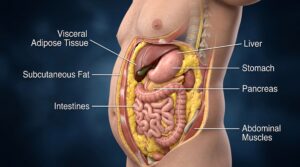
Why weight loss alone is not enough
Focusing only on weight loss can be misleading.
Because metabolic health can improve even without significant weight change.
For example:
- Exercise improves insulin sensitivity independent of weight loss
- Resistance training increases muscle, a key glucose “sink”
- Diet quality affects inflammation and metabolic signalling
- Sleep regulates hormones like cortisol and insulin
- Stress alters appetite, fat storage, and glucose control
In other words:
You can become metabolically healthier without becoming dramatically lighter.
And equally:
You can lose weight without fully restoring metabolic health.
This is where the conversation needs to mature.
A better model: fix the engine, not just the dashboard
If weight is the dashboard indicator, metabolism is the engine.
Our goal is not just to make the numbers look better.
It is to make the system work better.
That means addressing:
- Energy balance (yes, this still matters)
- Food quality and structure
- Muscle mass and physical activity
- Sleep and circadian rhythm
- Stress and psychological load
- Medication or surgical support when needed
Weight loss becomes a by-product of improved metabolic function, not the sole target.
Practical “hymns” for daily life
If this all sounds complex, here’s the good news:
The principles are simple.
They just need to be applied consistently.
Think of these as daily “hymns” habits you return to again and again.
- Protect your muscles
Muscle is your metabolic ally.
- Include resistance training 2–3 times per week
- Prioritise protein in meals
- Stay physically active daily
Muscle helps regulate blood sugar and supports a resilient metabolism.
- Eat for stability, not just calories
Not all calories behave the same.
- Reduce ultra-processed foods
- Emphasise whole foods: vegetables, protein, healthy fats
- Build meals that keep you full for hours
Stable energy leads to stable metabolism.

3. Move often, not just intensely
You don’t need to become an athlete.
- Walk daily
- Break up long sitting periods
- Use movement as medicine, not punishment
Consistency beats intensity.
- Respect sleep like a prescription
Sleep is not optional for metabolic health.
- Aim for 7–8 hours per night
- Maintain consistent sleep times
- Reduce late-night light exposure
Poor sleep can undo the benefits of good nutrition and exercise.
- Reduce the “invisible load”
Stress is a metabolic disruptor.
- Build moments of recovery into your day
- Use breathing, reflection, or quiet time
- Avoid constant overstimulation
A calmer system is a more regulated system.
- Play the long game
Short-term weight loss is easy.
Long-term maintenance is the real skill.
- Avoid extreme, unsustainable approaches
- Focus on habits you can repeat for years
- Expect plateaus and setbacks
This is not a sprint. It is a system reset.
So, can weight loss reverse metabolic disease?
Yes, in many cases, it can lead to remission or major improvement.
But it is not:
- A guaranteed cure
- A standalone solution
- Or the full story
Weight loss is best understood as one powerful tool within a broader metabolic strategy.
When we combine it with better nutrition, movement, sleep, and behavioural support, the results become more predictable, more sustainable, and more meaningful.
Final thought
Instead of asking:
“How much weight do I need to lose?”
A better question might be:
“How can I make my metabolism work better?”
Because when the system improves,
The weight loss often follows,
And more importantly, so does health.
If you found this discussion useful, you may be interested in my recently published book, “Your Metabolic Shift”, which explores these concepts in greater depth.
Frequently Asked Questions (FAQ)
- Can weight loss reverse type 2 diabetes?
In some people, yes. Significant weight loss — especially early in the disease — can lead to remission, meaning blood sugar returns to normal without medication. However, this is not a guaranteed cure, and long-term lifestyle changes are essential to maintain results.
- How much weight do I need to lose to see benefits?
Even modest weight loss can help:
- 5–7% of body weight → improves insulin sensitivity and reduces diabetes risk
- 7–10% or more → greater impact on liver fat, blood sugar, and cardiovascular risk
The key is not perfection, but meaningful, sustained change.
- Can I improve my metabolic health without losing weight?
Yes. This is an important and often overlooked point.
Exercise, improved diet quality, better sleep, and reduced stress can all improve metabolic health independently of weight loss.
- Why do some people lose weight but don’t get healthier?
Because weight is only one piece of the puzzle. Factors such as:
- Muscle mass
- Fat distribution (especially visceral fat)
- Genetics
- Sleep and stress
- Disease duration
All these influence outcomes. Health is more than a number on the scale.
- Is exercise necessary if I am already losing weight?
Yes. Exercise is critical, not just for weight loss, but for:
- Improving insulin sensitivity
- Preserving muscle mass
- Supporting long-term weight maintenance
Think of it as metabolic medicine, not just calorie burning.
- What is more important: diet or exercise?
This is not an either/or question.
- Diet plays a bigger role in weight loss
- Exercise plays a bigger role in metabolic health and maintenance
The most effective strategy combines both.
- Are medications or surgery a failure?
Not at all. They are valid, evidence-based tools.
For some individuals, especially with more advanced disease, they can be life-changing and even life-saving.
- What is the biggest mistake people make?
Focusing only on short-term weight loss.
The real goal is long-term metabolic health, which requires sustainable habits rather than extreme interventions.
References & Further Reading
- Lean MEJ, Leslie WS, Barnes AC, Brosnahan N, Thom G, McCombie L, et al.
Durability of a primary care-led weight-management intervention for remission of type 2 diabetes: 5-year follow-up of the DiRECT open-label, cluster-randomised trial.
The Lancet Diabetes & Endocrinology. 2023;11(8):557–567.
https://doi.org/10.1016/S2213-8587(23)00385-6 - American Diabetes Association Professional Practice Committee.
8. Obesity and Weight Management for the Prevention and Treatment of Type 2 Diabetes: Standards of Care in Diabetes—2024.
Diabetes Care. 2024;47(Supplement_1):S145–S157.
https://doi.org/10.2337/dc24-S008 - American Diabetes Association Professional Practice Committee.
Type 2 Diabetes Remission: A New Mission in Diabetes Care.
Diabetes Care. 2023;46(1):47–57.
https://doi.org/10.2337/dci22-0034 - National Institute for Health and Care Excellence (NICE).
Overweight and obesity management (NG246).
London: NICE; 2025.
Available at: https://www.nice.org.uk/guidance/ng246 - National Institute for Health and Care Excellence (NICE).
A guide for prescribing medicines to manage overweight and obesity (Technology appraisal guidance).
London: NICE; 2025.
Available at: https://www.nice.org.uk - Centres for Disease Control and Prevention (CDC).
Prediabetes: Your Chance to Prevent Type 2 Diabetes.
Atlanta, GA: U.S. Department of Health and Human Services; updated 2024.
Available at: https://www.cdc.gov/diabetes/prevention-type-2 - European Association for the Study of the Liver (EASL), European Association for the Study of Diabetes (EASD), European Association for the Study of Obesity (EASO).
EASL–EASD–EASO Clinical Practice Guidelines on the management of metabolic dysfunction-associated steatotic liver disease (MASLD).
Journal of Hepatology. 2024;80(3):672–743.
https://doi.org/10.1016/j.jhep.2023.11.002 - Hall KD, Heymsfield SB, Kemnitz JW, Klein S, Schoeller DA, Speakman JR.
Energy balance and its components: implications for body weight regulation.
The American Journal of Clinical Nutrition. 2012;95(4):989–994.
https://doi.org/10.3945/ajcn.112.036350 - Estruch R, Ros E, Salas-Salvadó J, Covas MI, Corella D, Arós F, et al.
Primary prevention of cardiovascular disease with a Mediterranean diet.
New England Journal of Medicine. 2013;368(14):1279–1290.
https://doi.org/10.1056/NEJMoa1200303 - Taylor R, Al-Mrabeh A, Zhyzhneuskaya S, Peters C, Barnes AC, Aribisala B, et al.
Remission of human type 2 diabetes requires decrease in liver and pancreas fat content but is dependent upon capacity for β cell recovery.
Cell Metabolism. 2018;28(4):547–556.e3.
https://doi.org/10.1016/j.cmet.2018.07.003 - Ross R, Blair SN, Arena R, Church TS, Després JP, Franklin BA, et al.
Importance of assessing cardiorespiratory fitness in clinical practice: a case for fitness as a clinical vital sign.
Circulation. 2016;134(24):e653–e699.
https://doi.org/10.1161/CIR.0000000000000461


