Walk into a modern supermarket and you’ll see a riot of colours, flashy packaging, health claims in bold type, and ingredient lists that read like a chemistry set. But your grandmother’s kitchen didn’t look like this. Her food didn’t shout; it whispered of gardens, seasons, and home. It was fresh, simple, and nourishing, and science is finally catching up to her wisdom.
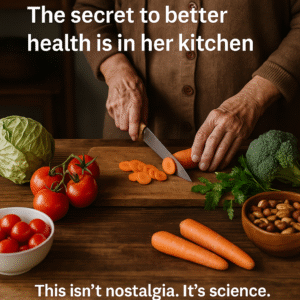
In an age of ultra-processed snacks and endless food labels, it’s easy to forget a simple truth: real food doesn’t need a label. Your grandmother knew this instinctively. Her kitchen wasn’t stocked with neon-coloured drinks or snack bars wrapped in shiny foil. It was filled with fresh vegetables, seasonal fruits, jars of nuts and seeds, and the comforting aroma of home-cooked meals.
Food didn’t need marketing. It just needed to be fresh, local, and made with care.
The Timeless Power of Whole Foods
Whole foods, those that come from the earth, from local farmers, or your own backyard, nourish the body in ways that no laboratory-made product can. They deliver not just nutrients, but the natural balance and synergy your body is designed to thrive on.
Take fibre, for example. It doesn’t get flashy advertising, but it’s a metabolic powerhouse. Fibre slows the absorption of sugar and fat, keeping blood sugar stable, energy levels even, and cravings at bay. It also feeds your gut microbiome, the trillions of friendly bacteria that live in your digestive system. These microscopic allies break down fibre into short-chain fatty acids, such as butyrate, a compound that reduces inflammation, repairs the gut lining, and even supports brain health.
No processed snack, no matter how “fortified,” can replicate that.
 Freshness is a Nutrient in Itself
In your grandmother’s day, most produce didn’t travel thousands of kilometres before reaching the table. Food was seasonal and local, picked at peak ripeness, rich in flavour and nutrients.
Fresh food isn’t just tastier, but it’s more potent. Vitamins, antioxidants, and enzymes degrade over time, meaning that the further and longer food travels, the fewer nutrients remain. Eating locally grown produce ensures you’re getting the maximum benefit from every bite.
Organically grown foods also spare you the chemical burden of pesticides and herbicides. Your grandmother didn’t call it “organic”. It was simply a matter of how food was grown.
When History Forced a Return to Simplicity
In the 1990s, US trade restrictions forced Cuba to rely heavily on locally grown, minimally processed foods. Without imported processed goods, the national diet shifted toward a greater emphasis on vegetables, legumes, and fresh produce. As a result, Rates of obesity, type 2 diabetes, and cardiovascular disease plummeted.
It’s a powerful real-world experiment that demonstrates what happens when a population returns to its natural state.
Similarly, the Mediterranean diet, rich in vegetables, legumes, olive oil, fish, and nuts, remains consistently linked to longer life, lower disease risk, and improved metabolic health. It’s not a fad; it’s the culinary heritage of entire cultures.
Science catches up with tradition
Modern research is finally confirming what tradition has long known: food can be a form of medicine.
Professor Roy Taylor at Newcastle University has demonstrated that a nutrient-dense, low-calorie diet can effectively reverse type 2 diabetes in some individuals. Not just manage it – reverse it. This is a staggering reminder that what’s on your plate has the power to change the course of chronic disease.
And the “treatment” is deceptively simple: whole, unprocessed, fibre-rich foods, exactly the kind of meals your grandmother might have prepared without needing a research paper to justify them.
Why Processed Foods Can’t Compete
Ultra-processed foods are engineered to hit your brain’s pleasure centres while doing very little for your cells. They’re stripped of fibre, pumped with refined sugars and industrial fats, and often packed with additives. They may fill your stomach quickly, but they leave your body overfed yet undernourished.
The result is blood sugar spikes, energy crashes, hormonal imbalances, disrupted gut bacteria, and chronic inflammation, the root of many modern diseases.
The Path Back to Kitchen Wisdom
Improving your health doesn’t require expensive supplements, complicated diets, or miracle powders. It requires one decisive shift: replace calorie-dense, nutrient-poor processed foods with fresh, fibre-rich whole foods.
Here’s how to begin:
Shop the perimeter of the store, where you’ll find fresh produce, meat, fish, dairy, and whole foods.
Buy seasonal and local produce whenever possible. Farmers’ markets are ideal.
Cook at home more often. Even simple meals from scratch are healthier than most restaurant or packaged options.
Avoid ingredient lists longer than a short paragraph, or better yet, buy foods without labels at all.
Reconnect with food preparation by embracing acts of care, such as chopping vegetables, soaking beans, and baking bread, rather than treating them as chores.
The Deeper Connection
Food is more than fuel. It’s culture, memory, and connection. The meals your grandmother made weren’t just nourishing your body; they were nurturing your spirit.
When we break down food into numbers and macros, we lose something deeply human. Cooking whole foods and eating together helps restore our connection to nature, to one another, and ourselves.
The bottom line
We’ve traded our grandparents’ fresh, home-cooked meals for ultra-processed snacks that are slowly eroding our health. Science now proves what tradition always knew: whole foods can heal, protect, and even reverse chronic disease, if we’re willing to return to the kitchen.
Your grandmother didn’t need “low-carb” labels, calorie-tracking apps, or approved recipes to know what was good for you. She trusted her senses, her traditions, and the land.
So, here’s the challenge: when the choice is between convenience and survival, which will we choose? Are we ready to reclaim the eating habits that once kept us healthy, resilient, and connected, or will we continue to outsource our well-being to food companies that put profit before people?
I’d love to hear your thoughts. Share your perspective in the comments, and if you’re ready to take the first step, I’ve created a free guide, ‘Your Body Knows How to Heal,’ to help you reset your metabolism. You can download it here https://www.drshariefibrahim.com/ and join the community for more practical tips and inspiration.