
What if your body is 10 years older than you are?
Imagine two 45-year-olds standing side by side.
One runs 5 km three times a week, carries groceries without effort, sleeps well, remembers names, and enjoys an active social life.
The other struggles with fatigue, joint pain, poor sleep, high blood pressure, prediabetes and relies on several medications.
Their birth certificates say they are the same age.
Their bodies tell a very different story.
This difference is what scientists call biological age.
Over the last few years, biological age testing has exploded in popularity. Companies promise to tell you your “real age,” often using blood tests, DNA methylation analysis, wearable devices, artificial intelligence, or sophisticated algorithms.
But how useful are these tests?
Can they really tell how old your body is?
Should you spend hundreds of pounds on them?
Or are they simply expensive guesses wrapped in scientific language?
The answer lies somewhere in the middle.

What Is Biological Age?
Your chronological age is simple: the number of years since you were born.
Your biological age attempts to measure how well your body functions compared with that of the average person of your chronological age.
Think of it like a car.
Two cars may both be 10 years old.
One has been serviced regularly, driven carefully, and stored in a garage.
The other has missed services, been driven aggressively, and spent years exposed to harsh weather.
Both are 10 years old.
Neither has aged the same way.
Humans are no different.
Some people age faster.
Others age slowly and gracefully.
Biological age estimates where you sit on that spectrum.
Research consistently shows that biological age predicts disease risk and mortality better than chronological age alone.
Why Biological Age Matters
The real value of biological age is not curiosity.
It is a prediction.
Many chronic diseases develop silently for years before symptoms appear.
Biological age may provide an earlier warning signal.
An elevated biological age has been associated with:
- Cardiovascular disease
- Type 2 diabetes
- Frailty
- Cognitive decline
- Cancer risk
- Earlier mortality
Think of biological age as the dashboard warning light in your car.
It does not tell you exactly what is wrong.
But it suggests you should lift the bonnet and investigate.
How Is Biological Age Measured?
Scientists have developed multiple approaches.
Each measures a different aspect of ageing.
- Blood Biomarker Clocks
These use routine blood tests such as:
- Glucose
- HbA1c
- Cholesterol
- Inflammatory markers
- Kidney function
- Liver function
The data are combined into algorithms that estimate biological age.
Advantages:
- Affordable
- Accessible
- Practical
Limitations:
- Influenced by temporary illness
- Less precise than newer methods
- Epigenetic Clocks (DNA Methylation Tests)
These are currently considered among the most advanced biological age tests.
They measure chemical tags called methyl groups attached to DNA.
These patterns change predictably with ageing.
Popular clocks include:
- Horvath Clock
- Hannum Clock
- PhenoAge
- GrimAge
- DunedinPACE
GrimAge and DunedinPACE are particularly interesting because they predict health outcomes and mortality better than earlier clocks.
Think of DNA methylation as tiny sticky notes attached to your genetic instruction manual.
The notes do not change the words.
They influence which pages are read more often.
Over time, these notes change in recognisable patterns.
Scientists use these patterns to estimate biological ageing.
- Proteomic Clocks
Proteomics measures thousands of proteins circulating in the bloodstream.
Recent studies show remarkable accuracy in predicting age-related disease and mortality risk.
Think of proteins as the workforce of the body.
Measuring them gives insight into what the body’s factories are currently producing.
- Wearable and AI-Based Systems
Some emerging tools estimate biological age using:
- Heart rate variability
- Activity levels
- Sleep quality
- Fitness metrics
- Continuous physiological monitoring
These are attractive because they provide continuous feedback.
However, they currently remain less validated than DNA methylation-based methods.
Are Biological Age Tests Accurate?
This is where things become complicated.
The short answer is:
Some are scientifically impressive, but none are perfect.
At the population level, biological age measurements clearly correlate with disease risk and mortality.
However, predicting an individual’s biological age is much harder.
Several studies have highlighted important limitations:
- Different biological age tests may give different results.
- Different tissues may produce different ages.
- Repeated testing can show variation.
- Some clocks disagree substantially with each other.
A person might receive:
- Biological age = 48 from one company
- Biological age = 54 from another
- Biological age = 51 from a third
Which is correct?
Possibly none of them exactly.
Possibly all of them partially.
The reality is that ageing is extraordinarily complex.
No single number can fully capture it.
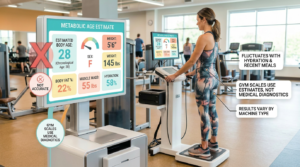
The Problem with Gym-Based Biological Age Scales
Many commercial scales found in gyms and health clubs estimate “metabolic age” or “body age” using:
- Age, sex, weight & height
- Bioelectrical impedance (BIA)
- Estimated body fat percentage
- Sometimes muscle mass and hydration
These devices do not actually measure biological ageing.
They are essentially comparing your body composition with population averages.
A useful analogy is that they are measuring the outside of the car, not what is happening under the bonnet.
Someone who is slim, muscular, and low in body fat
will often receive a younger “biologic age.”
Someone who is overweight and high in body fat
will often receive an older ” biologic age.”
The problem is that this assumes body composition reflects health.
Often it does, but not always.
A person can be Lean but insulin resistant with fatty liver
This phenomenon is sometimes called TOFI (Thin Outside, Fat Inside). People may look healthy yet carry excess visceral fat and metabolic dysfunction. The opposite can also occur: an athletic-looking individual may have excellent metabolic health despite carrying more weight.
This is why I would be cautious about calling these devices “biological age tests.” They are better described as body composition estimators with an age algorithm attached.
The Biggest Limitation Nobody Talks About
Imagine trying to assess the health of an entire city by looking only at electricity usage.
You would learn something useful.
But not everything.
That is the challenge with biological age testing.
Most clocks measure one dimension of ageing well.
But ageing is multi-dimensional.
It involves:
- Metabolism
- Inflammation
- Muscle mass
- Mitochondrial health
- Hormonal balance
- Brain function
- Immune function
- Stress resilience
- Social connection
Many modern researchers now argue that biological age clocks capture the pace of ageing but may miss an equally important concept:
Resilience, the ability to recover from stress and maintain balance.
In other words:
Two people may have identical biological ages.
One bounces back quickly from illness.
The other does not.
The clocks may not fully distinguish between them.
What Measurements Matter More Than Biological Age?
This may surprise you.
For many people, the most useful markers are not biological age tests at all.
Instead, focus on measurable indicators of health.
Muscle Strength
Grip strength predicts longevity remarkably well.
Weakness often predicts future health problems better than weight.
Muscle Mass
Muscle acts as your body’s metabolic engine.
More muscle generally means:
- Better glucose control
- Greater independence
- Lower risk of frailty
Waist Circumference
Often more useful than body weight.
Excess abdominal fat strongly predicts metabolic disease.
Blood Pressure
One of the simplest and most powerful predictors of future health.
HbA1C
Provides a window into blood sugar control and insulin resistance.
VO₂ Max and Fitness
Cardiorespiratory fitness remains one of the strongest predictors of survival.
Sleep Quality
Poor sleep accelerates ageing processes throughout the body.
Inflammation
Markers such as hs-CRP often reveal biological stress long before symptoms appear.
Should Everyone Get a Biological Age Test?
Not necessarily.
For researchers, clinicians, and highly motivated individuals, these tests can provide useful information.
For the average person, the results often confirm what common sense already suggests.
If you:
- Sleep poorly
- Eat ultra-processed food
- Rarely exercise
- Carry excess abdominal fat
- Feel constantly stressed
You probably do not need a £300 test to tell you that your biological age is increasing.
The bigger question is:
What will you do about it?
Why Some Less-Compliant People Appear Healthier
This observation frustrates many highly motivated patients.
The explanation often lies in what I call metabolic starting capital.
Imagine two people starting a business.
One inherits £1 million.
The other starts with £1,000.
Both make identical decisions.
Their outcomes may still differ dramatically.
Health works similarly.
Why Following the Same Programme Gets Different Results
A generic healthy lifestyle programme works for most people and should always be the starting point. However, when progress stalls, personalised medicine becomes increasingly valuable because it helps identify the unique barriers preventing improvement.
This is arguably one of the biggest challenges in preventive medicine.
Many health recommendations assume that all humans respond similarly.
Reality is far more complicated.
Imagine giving the same amount of water, sunlight, and fertiliser to three different plants:
- One flourishes.
- One grows slowly.
- One struggles despite receiving identical care.
Humans are similar.
The reasons include:
Genetics
Some people inherit genetic variants affecting:
- Insulin sensitivity
- Detoxification pathways
- Vitamin metabolism
- Inflammatory responses
- Fat burning
- Muscle building
- Neurotransmitter balance
Two people can follow the same diet and exercise programme and achieve very different results.
Epigenetics
Genes are not destiny.
However, previous life experiences can alter how genes are expressed.
Examples include:
- Trauma
- Chronic stress
- Childhood adversity
- Environmental toxins
- Nutritional deficiencies
- Previous infections
These can influence biological resilience for decades.
Hidden Obstacles
A patient may be doing everything “right” but still struggle because of:
- Sleep apnoea
- Gut dysbiosis
- Chronic inflammation
- Thyroid dysfunction
- Mold exposure
- Heavy metal burden
- Undiagnosed insulin resistance
- Hormonal imbalance
Without identifying these barriers, generic advice often produces disappointing results.
What This Means for Biological Age Testing
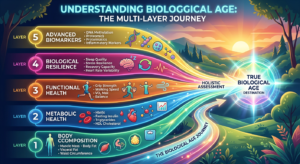
A useful biological age assessment should ideally include multiple layers:
Layer 1: Body Composition
- Muscle mass
- Body fat
- Visceral fat
- Waist circumference
Layer 2: Metabolic Health
- HbA1c
- Fasting insulin
- Triglycerides
- HDL cholesterol
Layer 3: Functional Health
- Grip strength
- Walking speed
- VO₂ max
- Balance
Layer 4: Biological Resilience
- Sleep quality
- Stress resilience
- Recovery capacity
- Heart rate variability
Layer 5: Advanced Biomarkers
- DNA methylation
- Proteomics
- Inflammatory markers
Only by combining these layers do we begin to approach a true picture of biological age.
The Bottom Line
Biological age testing is one of the most exciting developments in longevity science.
But it is not a crystal ball.
Nor is it a magic number.
Today’s biological age tests can provide valuable insights, especially DNA methylation-based clocks, which consistently predict disease risk and mortality better than chronological age alone.
However, they remain imperfect.
A single biological age score should never replace clinical judgment, lifestyle assessment, fitness measurements, metabolic markers, or common sense.
The most powerful anti-ageing strategy is not buying a test.
It is changing the behaviours that drive ageing in the first place.
Because the goal is not to have a younger biological age on paper.
It is to have more energy, stronger muscles, a sharper brain, greater resilience, and healthier years to enjoy life.
A younger biological age is simply the “receipt”.
The real reward is living better.
If you found this discussion useful, you may be interested in my recently published book, “Your Metabolic Shift”, which explores these concepts in greater depth.
Frequently Asked Questions
Can biological age be reversed?
Many studies suggest biological age markers can improve following lifestyle interventions such as exercise, weight loss, improved nutrition, stress reduction, and smoking cessation. However, the extent of true reversal remains under investigation.
What is the most accurate biological age test?
Currently, DNA methylation-based tests such as GrimAge and DunedinPACE are among the most scientifically validated.
Are online biological age calculators accurate?
Most provide rough estimates rather than precise measurements. They can be educational but should not be viewed as medical assessments.
Is biological age more important than chronological age?
For predicting health outcomes, biological age often provides more useful information than chronological age alone.
Should I spend money on a biological age test?
If you enjoy data and plan to use the results to guide behaviour change, it may be worthwhile. If you are unlikely to change your lifestyle, the test itself offers little value.
What is the single best anti-ageing intervention?
No single intervention exists. The strongest evidence supports combining exercise, muscle preservation, metabolic health, sleep optimisation, stress management, and whole-food nutrition.
This article is intended for educational purposes only and should not replace personalised medical advice. Readers with existing medical conditions should consult their healthcare professional before making significant dietary or lifestyle changes.
References
Foundational Biological Age and Epigenetic Clock Research
- Steve Horvath. DNA methylation age of human tissues and cell types. Genome Biology. 2013;14(10):R115.
- Morgan Levine et al. An epigenetic biomarker of ageing for lifespan and healthspan. Ageing (Albany, NY). 2018;10(4):573–591.
- Lu AT, Quach A, Wilson JG, et al. DNA methylation GrimAge strongly predicts lifespan and healthspan. Ageing (Albany, NY). 2019;11(2):303–327.
- Belsky DW, Caspi A, Arseneault L, et al. Quantification of the pace of biological ageing in humans through a blood test: DunedinPACE. eLife. 2022;11:e73420.
Biological Age and Longevity
- Ferrucci L, Levine ME, Kuo PL, Simonsick EM. Time and the metrics of ageing. Circulation Research. 2018;123(7):740–744.
- Kennedy BK, Berger SL, Brunet A, et al. Geroscience: linking ageing to chronic disease. Cell. 2014;159(4):709–713.
- López-Otín C, Blasco MA, Partridge L, Serrano M, Kroemer G. The Hallmarks of Ageing. Cell. 2013;153(6):1194–1217.
- López-Otín C, Blasco MA, Partridge L, Serrano M, Kroemer G. Hallmarks of Ageing: An Expanding Universe. Cell. 2023;186(2):243–278.
Biological Age Testing Limitations
- Higgins-Chen AT, Thrush KL, Wang Y, et al. A computational solution for bolstering reliability of epigenetic clocks. Nature Aging. 2022;2:644–661.
- Mavrommatis C, et al. Comparative performance of multiple epigenetic clocks in predicting health outcomes. Nature Communications. 2025.
Exercise, Muscle and Longevity
- Ruiz JR, Sui X, Lobelo F, et al. Association between muscular strength and mortality in men. BMJ. 2008;337:a439.
- Blair SN, Kohl HW, Barlow CE, et al. Changes in physical fitness and all-cause mortality. JAMA. 1995;273(14):1093–1098.
- Peterson MD, Rhea MR, Sen A, Gordon PM. Resistance exercise for muscular strength in older adults. Ageing Research Reviews. 2010;9(3):226–237.
Metabolic Health and Ageing
- Taylor R. Life Without Diabetes. Newcastle University Press. 2018.
- Fung J. The Obesity Code. Greystone Books. 2016.
- Lustig RH. Metabolical. Harper Wave. 2021.
- Ludwig DS, Ebbeling CB. The carbohydrate-insulin model of obesity. JAMA Internal Medicine. 2018;178(8):1098–1103.
Lifestyle and Longevity
- Buettner D. The Blue Zones. National Geographic. 2012.
- Buettner D. The Blue Zones Challenge. National Geographic. 2017.
- Waldinger RJ, Schulz MS. The Good Life: Lessons from the world’s longest scientific study of happiness. Simon & Schuster. 2023.