
Barbra did everything right.
She exercised daily: yoga in the morning, swimming or walking later in the day. She ate carefully, favouring fibre, whole foods, and low-sugar meals. Her weight had been stable for years, her body mass index firmly in the “healthy” range.
And yet, her blood sugar refused to cooperate.
Routine blood tests kept returning the same quiet warning: prediabetes. Not severe enough to warrant medication, but persistent enough to warrant concern. The usual advice eat better and exercise more felt misplaced. She was already doing exactly that.
Something didn’t add up.
Why “Normal Weight” Isn’t Metabolically Normal?
The first clue came not from the scales, but from a tape measure.
Despite her normal BMI, Barbra’s waist circumference was elevated, her waist-to-hip ratio was higher than ideal, and her neck circumference subtly increased. These measurements matter because where fat is stored often predicts metabolic risk more strongly than total fat mass.
Research has consistently shown that visceral fat, the fat stored deep around the abdominal organs, is far more metabolically harmful than subcutaneous fat, driving insulin resistance, inflammation, and cardiometabolic disease (Fox et al., 2007; Després, 2012). This is why waist circumference has been described as a “vital sign” in clinical practice (Ross et al., 2020).
Barbra didn’t have a weight problem.
She had a fat distribution problem.
The Clue That Only Appeared While She Slept
To understand why her glycated haemoglobin remained elevated, we used continuous glucose monitoring (CGM).
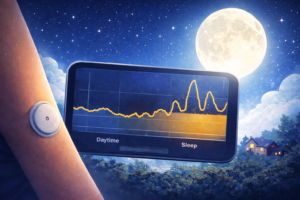
During the day, her glucose levels were unremarkable—steady, stable, and well-regulated. But at night, the pattern changed dramatically. While she slept, her glucose spiked repeatedly.
This pattern is increasingly recognised in people with early metabolic dysfunction. CGM can reveal glucose abnormalities that standard fasting tests and HbA1C completely miss (Monnier et al., 2007; Hall et al., 2022).
Night-time glucose spikes are rarely about food. They are usually about stress physiology.
A Diagnosis Hidden in Plain Sight
When asked directly about her sleep, Barbra hesitated. She snored loudly. She woke unrefreshed. She felt tired despite spending enough hours in bed.
A sleep study confirmed the diagnosis: moderate-to-severe obstructive sleep apnoea, with approximately 30 breathing pauses per hour.
Obstructive sleep apnoea is not just a sleep disorder. It is a powerful metabolic disruptor. Each apnoea episode triggers a surge of stress hormones, raises blood pressure, and temporarily worsens insulin resistance, sometimes hundreds of times per night (Tasali et al., 2008; Reutrakul & Mokhlesi, 2017).
This explained everything: the nighttime glucose spikes, the elevated fasting glucose, and the creeping blood pressure.
CPAP helped, but it wasn’t the end of the story
Treatment began with CPAP therapy, which prevents airway collapse during sleep. The response was rapid. Night-time glucose stabilised, blood pressure improved, and her long-term glucose marker (HbA1C) returned to the normal range.
This is well documented in the literature: treating sleep apnoea can significantly improve glucose regulation and insulin sensitivity (Babu et al., 2005; Pamidi et al., 2015).
But CPAP was never intended as the final solution.
It treated the symptom rather than the cause.
The Real Target: Visceral and Upper-Body Fat
The deeper question was why Barbra’s airway was collapsing in the first place.
One major contributor is upper-body and visceral fat, including fat stored around the neck. Neck circumference is a surprisingly strong predictor of sleep apnoea risk, even independent of BMI (Ben-Noun & Laor, 2006; Onat et al., 2009).
The goal, therefore, was not weight loss; it was fat redistribution.
 How Can We Reduce Visceral Fat Sustainably?
Rather than extreme diets or punishing exercise, the focus was on physiology-friendly changes.
Strength training was prioritised to build muscle, which improves insulin sensitivity and glucose disposal. Evening meals were brought forward to reduce overnight metabolic demand. Protein intake was optimised to preserve lean mass while allowing visceral fat to gradually decline.
Alcohol was avoided in the evening, as it relaxes airway muscles and worsens sleep apnoea. Nasal airflow was supported, and sleep timing became more consistent to stabilise circadian rhythms, a key regulator of fat distribution and glucose metabolism (St-Onge et al., 2016).
Individually, these changes were modest. Together, they were powerful.
Over time, her waist circumference fell, her waist-to-hip ratio normalised, and her neck circumference reduced. As mechanical pressure on the airway eased, sleep quality improved naturally.
Eventually, CPAP was no longer needed.
Her glucose remained stable day and night.
What This Case Teaches Us
Prediabetes is often framed as a failure of willpower or lifestyle. But this case highlights a more nuanced truth.
Sometimes, the real problem isn’t food or exercise.
Sometimes, it is sleep, stress physiology, and where the body stores fat.
Visceral fat can hide behind a normal BMI. Sleep apnoea can exist without obvious obesity. And glucose dysregulation can quietly unfold while a person sleeps.
When we measure the right things—waist circumference, neck circumference, and glucose pattern the picture becomes much clearer.
Final Thoughts
Prediabetes doesn’t always shout. Sometimes it whispers in the quiet hours of the night, in a rising glucose trace, in a tape measure pulled just a little tighter around the waist.
When we listen carefully, we can often reverse the process, not with greater effort but with deeper understanding.
“Your Metabolic Shift” book copy is here https://tinyurl.com/3yj6rjff
References
Fox CS et al. Circulation. 2007 – Visceral fat and metabolic risk
Després J-P. Circulation. 2012 – Body fat distribution and cardiometabolic disease
Ross R et al. Nat Rev Endocrinol. 2020 – Waist circumference as a clinical vital sign
Monnier L et al. Diabetes Care. 2007 – CGM in impaired glucose tolerance
Hall H et al. Diabetes Care. 2022 – CGM use beyond diabetes
Tasali E et al. Am J Respir Crit Care Med. 2008 – Sleep apnoea and insulin resistance
Reutrakul S, Mokhlesi B. Chest. 2017 – OSA and diabetes review
Babu AR et al. Arch Intern Med. 2005 – CPAP and glycaemic control
Pamidi S et al. Am J Respir Crit Care Med. 2015 – CPAP effects on glucose metabolism
Ben-Noun L, Laor A. Exp Clin Cardiol. 2006 – Neck circumference and sleep apnoea